Widdershins:

(sometimes withershins, widershins or widderschynnes) means to take a course opposite that of the sun, going counterclock-wise, lefthandwise, or to circle an object, by always keeping it on the left. It also means "in a direction opposite to the usual," which is how I choose to take it in using it as the title of this blog. We're all in the same world finding our own way.

Tuesday, May 17, 2016

Every Time We Touch

I have a confession to make:

I am terrified of physical intimacy with other men. But at the same time, I crave it. When I want to feel physically comforted, my first instinct/desire is to want it from the men in my life (even though I'm much more likely to be readily supported and listened to by the women who love me).

I'm slowly realizing that growing up queer in a homophobic, hetero-patriarchal world kind of fucked me up more than I like to admit and as a result I have underlying insecurities around any kind of physical intimacy with men who I am not romantically or sexually involved with.

Participating in a Free Hugs
and (Hershey's) Kisses event
in undergrad
And you may be thinking to yourself, Danny, you're queer. You've been with the same partner for four years in a stable, healthy relationship, you offer hugs and are super touchy and gentle and vulnerable with people all the time.

To which I must say, you're right, I am physically and emotionally intimate with people all the time.

Actually being intimate and being afraid of intimacy are not mutually exclusive.

I would argue that my fear (though maybe deep-seated anxiety is a better phrasing) is not innate, but rather a manifestation of a culturally ingrained stigma born out of societal homophobia. It's learned. Before you read on, I encourage you to check out this article by Mark Greene on the Goodmenproject about what he calls touch isolation and how homophobia creates a culture wherein men aren't allowed to touch each other.

My willingness to be intimate with other men is also learned: by exposing myself to an inclusive, diverse arts community, by being actively queer, basically I have expanded my comfort zone by existing at and interacting with the margins of society where the strict boundaries of "normal" behavior are blurred.

If I'm insecure or anxious, it is because society has taught me that I should only be allowed that physical intimacy, that closeness, in certain kinds of relationships. The underlying fear can best be encapsulated by the question: will this be conceived as sexual contact? It's the internalized conflict between a hypersexualized gay culture (all contact between two men is or will become sexual) and certain aspects of homophobic cultural conditioning (contact between two men should never be sexual) with the reality that not all touch is inherently sexualized and even if it is, that's not always a bad thing.

 Even within my own personal experience this isn't universally true. After all, I'm a notorious cuddler with close friends. Pet me. Hug me. Trade massages. Brush my head with your elbow. Touch is very important to my life.

My head being brushed with an elbow.
I've been actively unlearning this social conditioning for years now, but sometimes it still catches me off guard. It's compounded by the specific ways in which as a queer man I have to unravel and separate the various forms of attraction, desire, lust, like, and love that I can feel for any given man at any given time, and usually there's more than one happening at the same time. This isn't always an easy task.

So is a hug just a hug or is it a hug?

It depends. Sometimes it's both.

What I'm trying to unpack here is that I don't think physical intimacy is something to be afraid of. We can touch, hug, cuddle, kiss, whatever and it doesn't have to be a Thing. It can just be the base comfort of sharing space and company. I want that for myself. I want that for you.  Otherwise we are depriving ourselves for nothing.

And to the men in my life that I can be vulnerable with, where the hugs last just long enough to make the occasional person watching uncomfortable, who will hold my hand while we sit in silence, those shoulders to lean on even when I don't need support, know I appreciate you. You're helping me overcome a lifetime of deprivation.

As a endnote to this post, I would like to address the role of consent in these interactions. All too frequently we talk about consent in terms of sex, but part of recognizing and honoring the body autonomy of the people we interact with is by establishing boundaries and communicating. Some people aren't okay with touch. So ask. Can I hug you? Want to cuddle?

Offer alternatives. Hand-hug instead of full body hug. Sit next to each other instead of on each other.

Meet people where they're at. Men especially in our culture can take some time to warm up to the idea of body contact that isn't explicitly sexual or aggressively nonsexual (sports/roughhousing), but give them the option. Create space and opportunities to be close, but with the option to opt out if it's too much.

Tuesday, May 10, 2016

What Are You? A Personal Intersection of Race, Identity and Queerness

"So... What are you?"

It's an innocuous enough question in most circumstances, awkwardly phrased with downturned eyes, like the person asking doesn't know if they're allowed to ask. Sometimes it's worded differently: "What's your ethnicity?" or "Where are you from?"

If you're not white and living in the United States, you're familiar with this song and dance. You may even get it often enough to be annoyed, perhaps even offended. It is, after all, one of those microaggressions continually reminding you of your non-whiteness, branding you as Other. You are not white, therefore you are not really of here. However innocent, it's an interrogation based in our American cultural obsessions with race and identity.

But this post is only partly about that. Call this post a confession and an answer. See, I struggle to answer these questions.

I was raised just outside a small city in Washington called Puyallup. It was the suburbs; a pleasant - if homogenously bland - existence where everyone needed a car to get around. The area was mostly white and grew dramatically through my childhood and adolescence with the housing boom of the late-nineties and early-noughts.

My parents both grew up in West Seattle. My mother raised by an immigrant who gave me her dimples, my father by the kind of straight-laced couple who have lived in the same house for decades, who seem more a part of the landscape than the characters passing through.

A week after I graduated high school, my mom pulled me aside.

Russell isn't your father, she told me. Your brother is actually your half-brother. Your biological father is actually a man named Joseph.

It was a shock, but not world shattering. Call it the weary resilience of a child of divorce combined with the stability that comes from a strong sense of community and selfhood. I carry the name of my father but do not share his blood.

"So... What are you?"

Well, through my mom I'm a quarter Japanese and a quarter German-American. On my dad's side... I don't know.

I'm clearly not white. I'm what a self-aware sitcom might jokingly refer to as "vaguely ethnic." I have olive skin that ripens under the summer sun into a glowing brown. My eyes slant just enough to give me away. I could be mixed Hispanic, or maybe Philipino, or Persian. I'm a mutt of indeterminate origin, the beautiful bowl of soup poured straight from the melting pot. I'm the beige future that racist white folk whisper about in fear when discussing interracial relationships.

Here's an excellent study in contrast of me dancing with my friend Gabe.

I've seen pictures of my biological father. Volunteered to me without request, but have never had an interest in seeking out contact. Who would this stranger with his own family and life be to me? What would I be to him, an adult son with a life already his own?

I don't need another father.

Still, it leaves me at an impasse. I do not know my roots. I do not have a tidy little pedigree to present on command. I am mixed unknown, American as individually-wrapped sliced cheese product.

As a result, like many mixed race kids, I've rarely felt like I belong -- at least when it comes to matters of race. Despite my upbringing, I've never been white. The social studies teacher in junior high who tried to call me Mr. Miyagi more than proved that point. If I'm curious, I could always do one of those genealogy tests. Swab my mouth and send it to a lab, receive a chart and map in the mail. But without a connection to culture, I've never felt comfortable partaking in many of the social safe spaces for my POC peers (welcoming as they may be).

I’ve studied the language and history and culture of my maternal grandmother and even visited Japan once long ago, but as much as I ache for cherry blossoms in the spring, I will always be a foreigner.

It took a trip to Boston to finally see my first spring sakura in New England.


And I guess this is all a part of what makes me queer, really.

LGBTQ-folk in America have a long narrative history of the “adopted” or “chosen” family because so many of us are still getting disowned and cast out by our birth families. So we surround ourselves with people who will love and support us.

I have my birth family: My mother and brother and step-father who I don’t call as often as I should. My partner’s amazing extended family who are so happy to see that I make him happy.

I also have my chosen families: My Charlie-sis who took me to my first concerts and dragged me to my first dance lesson. The expansive Power of Hope community that has nurtured my heArtistry for years. All the Poets who stare at the moon. My QTs (Meow). And everyone else who holds me accountable and pushes me to grow and love.

I have a tattoo of the symbol for mercury on my right forearm.

It’s there as a reminder of my own liminality, that someone has to fill in the blanks, read between the lines, exist in spaces between. Despite what American misconceptions may force on me, I am more than my race. I am more than my skin tone. You don’t need to know what I am to know who I am.

Friday, November 13, 2015

A Millenial's Guide to Technology

If you're reading this post, congratulations!

You've managed to turn on a computer, connect it to the internet through either a ethernet cable or wifi, open a browser and through either clicking on a Facebook link or clicking a link on a Google search.

If you're saying to yourself, "Yeah, Admiral Obvious, get to the point." Then this post probably isn't for you.

If you're wondering what a browser is, then please, read on.

This post is by no means comprehensive, it probably won't tell you what to do to fix your specific problem, but if you read on you might learn the methods you can use to

Chances are you're the parent or grandparent of a Millennial or Gen Z (iGen, post-Millennial, whatever). They're the 10-30 year old offspring you turn to when you have a computer problem, and they get frustrated. They roll their eyes and act like you've asked them the stupidest question in the world when you tell them your internet won't work and can they please come fix it even though they live three hours away (love you mom).

Still wondering what a browser is? It's a program on your computer that connects you to the internet. You might know it better as Firefox or Chrome or Safari or Edge or (please get help switching to ANYTHING ELSE) Internet Explorer. You might only know it as the colorful icon (small image you click on to "open the internet") that each of these programs uses.
The five most common internet browser icons.
See, it's not that we millennials think you're stupid. We think you're technologically incompetent even though you managed to print off and bring home chain emails and jokes from work years before most of us were glued to the screen. Which is okay. Technology, especially the internet variety has been changing at a very fast pace. You've probably read about it in a newspaper or heard about it on the local news (meanwhile your kids are reading blog posts on social media that make fun of the fact that you still read a physical newspaper and watch the local news even though corporate media is controlled by the 1% and frames most of what it shows in highly biased ways despite the lofty journalistic goals of objectivity).

So how do you keep up?

First and foremost you have to be willing to experiment. If your kid is fixing your computer for you, unless you've done something devastatingly wrong like wipe the entire contents of your hardrive (which how you could do that on accident is beyond me), they're probably just clicking around randomly until they find something that looks like it might be working. 

It just looks like computer magic because their reflexes are a lot faster than yours. Most of us can tell if clicking on something helped within two seconds. That's why when your wonder child is at work windows (the screens on your monitor, a.k.a. the part of the computer you look at) seem to pop up and disappear before you get a chance to look at them.

Second (if you're connected to the internet), Google is your friend. Or at least your merciful Search Overlord. 

You've used Google. You've probably even used Bing and Yahoo or even Ask back in the day. They're search engines that look at everything on the internet for pages relevant to whatever search terms you've entered. Technically when someone tells you to "Google something" they mean "Use the Google webpage to search something" or sometimes just "look something up on the internet" (though Google doesn't like the latter so much).

But sometimes Google doesn't give you what you want. 

Pop quiz!

You hear a song you like on the radio and the DJ doesn't mention the name or the artist so when you get home you decide to Google it. What do you put into the search bar?

If you answered something along the lines of "What is the name of the ______ song?" or "Who sings the ________ song?" You're not searching like a millennial.

You see, most search engines are what's called keyword-based searches. You put in the most important/relevant information and it searches the internet for those keywords and ranks them by whatever system that site uses. Asking questions like the above are what's called natural language searches because they sound like natural language. You're asking the same way you would ask your friend Susan.

A millennial would take the a few words from the chorus of the song and add the word lyrics to the end of the search. 

Compare the search results you get from "If your love was a broken stereo lyrics" to "Who sings the broken stereo song?" Completely different. And if you're looking for the Sean Fournier song, one will get you better results.

This means of course that in order to troubleshoot your computer problems you'll have more success if you search like a millennial. How do you get the results you want?

You have to know what your problem is and if you don't know, make an educated guess. Is it a hardware or software problem (is it a thing you use to work the computer not working like your mouse or keyboard or a program you've installed on your computer)? Are you on a touchscreen device or a computer/laptop? Is there an error message?

Error messages, even though they're telling you something is wrong are a huge help toward fixing your problem. If you can, never close (x out of) an error message until you've written down what the error message says. They usually tell you what's wrong or have something like "Error x300n9" that you can Google. Because if you have an error, guaranteed someone else on the internet has had that same error and has either posted how they fixed it or gotten help from whatever company makes the program/computer causing the error.

Information like brand, model, version of whatever program you're having trouble with can all help you find what you're looking for. The more specific you can be about what's wrong, the more likely you are to have success. 

"Mouse won't click" is better than "mouse won't work."

Sometimes you can't look things up with Google. Maybe your internet isn't working for one of a variety of potential reasons and that's the problem you're trying to fix. 

Left to fend for yourself you have to resort back to that click until something works method. If it helps, pretend you're an archaeologist studying a dead culture's technology. Use the scientific method

If the internet is the problem, is it really the problem? You might have noticed back when I was talking about browsers that they connect you to the internet, but they aren't your connection to the internet. That's either the wireless router (wifi) or ethernet cable connecting your device to the modem (the thing plugged into the wall that you probably got from your internet provider). If you're on wireless, first ask if it's just your device having issues or all of them. That will change whether or not you try to fix your router or you computer. 

General rule of thumb, make sure everything is turned on properly. If on wireless, make sure your device is connecting to your router. You can find that either in settings or by clicking the thing on your computer that looks like some variation of this:


It's an old joke, but sometimes turning your computer off and back on again can reset whatever is causing your problem. Know where the power button is.

Lastly, and this is the most important one on here, know when something is beyond your ability to fix. I know this post is all about teaching you to be self-sufficient out in the world wide web. This is particularly true of hardware problems, unless you feel comfortable and confident in your ability to take apart your computer and replace parts without breaking anything. 

If you're on the phone with tech support (whether that be your offspring or a customer service rep) be nice, answer their questions, stay calm, if you get to a point where you think you know what you're doing, tell them if you click on or enter anything because they're probably going down a giant checklist and if you skip steps it will confuse them.

tl;dr here's a handy xkdc flowchart that you can refer to.

Much props to this post for inspiring me to write this. 

Monday, October 12, 2015

National Coming Out Day 2015: Questions, Comments, Concerns

I owe a huge debt to the women, trans folk, and people of color in my life for making me aware of these kinds of issues. Any thought relating to social justice is intersectional and relates to issues of queerness and it would be irresponsible of me not to acknowledge that up front. I think about it constantly because I'm surrounded by it and I couldn't name the dozens of sources that implicitly or explicitly influenced this post through Facebook posts, tumblr links, articles (academic or otherwise). But I wouldn't/couldn't say this without you.

I've been "out" my entire adult life.

What that means has changed and evolved over the years from the somewhat scared and questioning teenager devouring every scrap of (sometimes dubiously age-appropriate) information available at the local library to the internally raging queer questioning everything sitting at their computer writing for you today. So yesterday when I posted on Facebook for National Coming Out Day, I wasn't surprised that the majority of responses were loving and supportive. I've long since backed away from the kind of people who wouldn't love me and people like me.


But this isn't an "It Gets Better" moment.

While coming out is a continuous action, I'll save you the Gender Trouble spiel on discursive repetition and performativity. No matter how "out" you are, there will always be people and institutions too ignorant or oblivious to know without it being spelled out. That's called heteronormativity and is part of the larger cultural problem of assuming everyone we meet is straight until proven otherwise. I'm guilty of it (not as much as 10 years ago and I'm better at internally questioning that assumption, but such is the pain of the culture I was raised into).

So why come out?

First, I want to specify my use of queer as opposed to gay. I know there's still a lot of intra-community debate over the use of the term queer. Historically it has been used as a slur and a lot of people are uncomfortable with the associations that can be drawn from the archaic definition where it means weird. Those are valid reasons not to label yourself queer. As a college-educated person, I take the more postmodern route where queer is an anti-label. I'm okay with you calling me gay, but identifying myself as queer I'm saying you can never be fully sure what I mean. I could mean I'm bisexual, pansexual, aromantic homosexual or one of myriad sexual orientations that make up our beautiful alphabet soup. Complicate that with the fact that queer has also been used as an umbrella term to encapsulate the entire LGBTQAA2I+ and this too has been contested. In short:

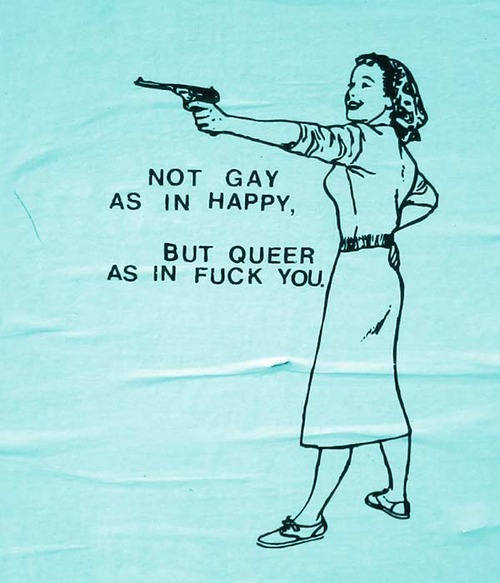
Not gay as in happy, but queer as in fuck you.

Question sexuality. Question your sexuality. Question ideas of romance and attraction. Even if you're sure you're straight, there's always room for questioning. What does that mean to you? Where do you draw that line? What is gender or sex and why do you base your sexuality on the gender of your partner instead of other characteristics that make them such an awesome person? Do you differentiate between romantic vs sexual feelings and how does that affect your perception of self?

Second, I come out because I'm in a safe and secure place to come out. I'm supported. I'm in a loving relationship. I don't experience a constant threat of violence because of my sexuality.

There's a lot of radical queer reaction to National Coming Out Day as a compulsory outing where it's found problematic that there's this perception that if you're lesbian or gay or queer and don't come out you're a shame to the community. And I agree. That kind of thinking is wrong. Because even if you stay in the closet, you're just as queer as anyone else. Come out when and to who you want to. If that means only the one confidant you trust, the whole world, or anonymous strangers on the internet, that's your choice and that's valid. And if anyone outs you without your consent, please give them hell (and take this as a warning not to do so).

We have a huge infrastructure problem for queer folk in most of the world. Addiction centers and homeless shelters and most schools aren't equipped to handle the unique pressures and challenges faced by LGBT people. There are places where you can get fired for no reason. And other places where you can't look/act gay without threat of physical violence. Throw in racial diversity or disability or refusal to comply with gender norms and I'm sure you can see how much of a struggle it can be just to exist. It's a dangerous world out there if you're too far from socially designated "normal." For a lot of people there are more pressing concerns than being out. Being out and being a role model is good and all, but collectively we've got a lot of work ahead of us.

National Coming Out Day is like the Hallmark version of Valentine's Day but put on by Big Gay Inc. It's mostly for show, gives extra treats to those who can afford it and leaves some people out in the dust. But there is good that can come of it and that's what I want to focus on here.

Third (they always have to come in threes), I can come out because I have the privilege of support to make it safe to do so, and by making myself more visible, I'm inviting anyone reading this to contact me. Ask questions. Use me as a sounding board for your own exploration. I might not have all your answers and I can't tell you what/who you are, but during undergrad I worked in offices called the Queer Resource Center (formerly the Lesbian Gay Bisexual Transgender Alliance), Sexual Awareness Center and the Women's Center, I've probably heard or read something similar before. I have access to resources, I know people, and at the very least I might be able to rephrase your question to help you get the kind of answers you're looking for. If you worry your question is offensive, I'll tell you why but I'll do my best to answer anyway. No judgments and confidential.

That's what I meant when I said "like the truth, we're out there."

Unless you've deliberately cut them out of your life and are vitriolically anti-LGBT (in which case congrats on finding this post and reading this far hopefully something I've said has pushed you to reconsider), you know queer people. Statistically it's true, but also you don't know the sexuality of the people around you (remember that heteronormativity I mentioned?). Just because a man and a woman are in a relationship doesn't mean either or both of them are straight. Bi- and pansexuality aren't nullified by relationship status.

They might be in the closet. They might be out to everyone except you. They might not be out to you because it hasn't come up yet. They might be flaming rainbow colors and because you've never been exposed to queer communities you have no references to identify clear and intentional signifiers that this person is anything but straight (yes, this happens, and full disclosure, when queer people hang out we do discuss the artful obliviousness of the straight people we're made to interact with because of school or work because the logical leaps a person will make to ignore the fact that a queer person is frothing rainbows and anti-assimilationist theory right in front of them are the stuff that queers stand-up is made of).

I'm not coming out for me. Some people do and find empowerment in owning their sexuality. Good for them. I'm coming out for the questioning kid sitting quietly in the front row to fly under the radar, for my straight friends whose minds are currently in process of being blown. I'm coming out because there's way more in this world than most of us care to explore.

Saturday, September 27, 2014

White men being violent assholes

or why I'll always pick a shitty, campy queer film over a critically-acclaimed American television drama

Look, I'm not going to hold it against you for liking things like Breaking Bad or True Detective or what have you crime drama on FX or HBO. There are lots of them and many of them are amazingly done with great storylines, beautiful cinematography, superb acting, and probably unnecessary amounts of misogyny (implicit or otherwise).

But most of them can be boiled down to one simple, five-word description: white men being violent assholes.

And I have absolutely no interest in that. It's partly the whole realistic crime drama thing, I don't care to indulge in the Great American Pastime of glorified Cops and Robbers (now in HD). But it's also definitely the violent white assholes. If you put it on for me, I'll get on my computer and pay little enough attention that I couldn't tell you more than what happened a minute ago.

It's a violent kind of apathy,  the kind where I'm sure if you had a camera pointed at me you could watch my eyes glaze over into a blank haze of disinterest. Even talking about it now, I'm struggling to express exactly how much I don't care because that means I have to fake caring enough to express it, but for you, I'll power through.

It's not just the violence, I've watched films like Lars von Trier's Antichrist and found the gritty, gore perfectly acceptable. The film wouldn't have worked without it. I was a fan of MTV's Teen Wolf until the writer's decided to kill of Allison's character when the actress decided she didn't want to continue working on a show that wasn't fully utilizing her talents (at least that's how I understand it).

It's not the white men or them being assholes, the majority of our media is saturated with that (because we Americans are kind of assholes, just look at our news). I love Australian Josh Thomas's brainchild Please Like Me which is mostly about white men being assholes (but in a funny Australian way as they try to figure themselves out) with the occasional racist characterization of one of the characters.  I've laughed at almost two seasons worth of The League, which is a comedy about "friends" in a fantasy football league together rife with sexist, racist, homophobic, etc language being horrible to each other in the name of competition.

Perhaps what I don't like is the way these violent white assholes are glorified. They're the protagonists and while by no means is it ever implied that we're supposed to emulate them (infiltrate underground crime rings or start meth labs, etc), they often end up living very sad, broken lives, but in allowing ourselves to be caught up in the viewing we identify with them. We are caught in the whirlpooling spiral that is their tragedy; it's not glorification in the sense that there is glory, but an elevation of focus.

I'm not about that.

So why shitty, campy queer films? There's very little (if any) cinematic merit to most of them and the acting is horrible at best, but my Netflix history is littered with them (usually marked with one or two stars), and to be honest, I don't really watch them either, it's more that choose to put them on in the background while I do other things.

You could make the argument that I myself am a shitty, campy queer, which wouldn't be too far off the mark. We so often like to allow ourselves to play into that narcissistic tendency of staring at ourselves after all. But I'm not a fantasy footballer (I've lived near Seattle all my life and still couldn't pick Russell Wilson out of a lineup) or Australian or a werewolf. I don't tune out when my roommate puts on Fringe or when my boyfriend puts on sports anime.

So if it's not the violence or the whiteness or men or the assholes, then my only conclusion is that it's something about the combination of all of these in the context of an American drama that bores me. That no matter how "good" it is, you'll never get me to watch it.

And I guess all I have to say to that is feel free to invite me to your next tv marathon, but don't be surprised if I wander off to the kitchen to make snacks.