I've been "out" my entire adult life.
What that means has changed and evolved over the years from the somewhat scared and questioning teenager devouring every scrap of (sometimes dubiously age-appropriate) information available at the local library to the internally raging queer questioning everything sitting at their computer writing for you today. So yesterday when I posted on Facebook for National Coming Out Day, I wasn't surprised that the majority of responses were loving and supportive. I've long since backed away from the kind of people who wouldn't love me and people like me.

But this isn't an "It Gets Better" moment.
While coming out is a continuous action, I'll save you the Gender Trouble spiel on discursive repetition and performativity. No matter how "out" you are, there will always be people and institutions too ignorant or oblivious to know without it being spelled out. That's called heteronormativity and is part of the larger cultural problem of assuming everyone we meet is straight until proven otherwise. I'm guilty of it (not as much as 10 years ago and I'm better at internally questioning that assumption, but such is the pain of the culture I was raised into).
So why come out?
First, I want to specify my use of queer as opposed to gay. I know there's still a lot of intra-community debate over the use of the term queer. Historically it has been used as a slur and a lot of people are uncomfortable with the associations that can be drawn from the archaic definition where it means weird. Those are valid reasons not to label yourself queer. As a college-educated person, I take the more postmodern route where queer is an anti-label. I'm okay with you calling me gay, but identifying myself as queer I'm saying you can never be fully sure what I mean. I could mean I'm bisexual, pansexual, aromantic homosexual or one of myriad sexual orientations that make up our beautiful alphabet soup. Complicate that with the fact that queer has also been used as an umbrella term to encapsulate the entire LGBTQAA2I+ and this too has been contested. In short:
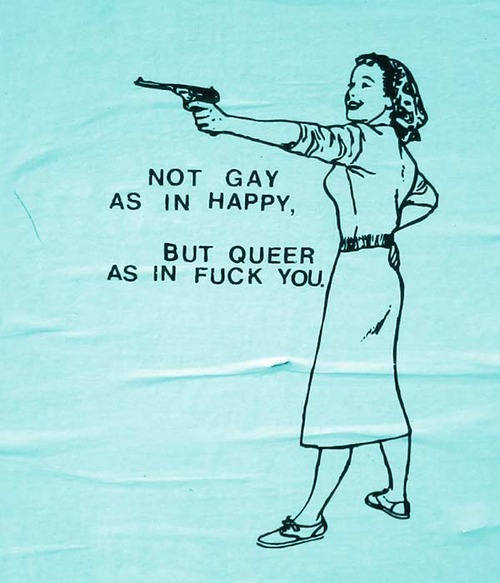 |
| Not gay as in happy, but queer as in fuck you. |
Question sexuality. Question your sexuality. Question ideas of romance and attraction. Even if you're sure you're straight, there's always room for questioning. What does that mean to you? Where do you draw that line? What is gender or sex and why do you base your sexuality on the gender of your partner instead of other characteristics that make them such an awesome person? Do you differentiate between romantic vs sexual feelings and how does that affect your perception of self?
Second, I come out because I'm in a safe and secure place to come out. I'm supported. I'm in a loving relationship. I don't experience a constant threat of violence because of my sexuality.
There's a lot of radical queer reaction to National Coming Out Day as a compulsory outing where it's found problematic that there's this perception that if you're lesbian or gay or queer and don't come out you're a shame to the community. And I agree. That kind of thinking is wrong. Because even if you stay in the closet, you're just as queer as anyone else. Come out when and to who you want to. If that means only the one confidant you trust, the whole world, or anonymous strangers on the internet, that's your choice and that's valid. And if anyone outs you without your consent, please give them hell (and take this as a warning not to do so).
We have a huge infrastructure problem for queer folk in most of the world. Addiction centers and homeless shelters and most schools aren't equipped to handle the unique pressures and challenges faced by LGBT people. There are places where you can get fired for no reason. And other places where you can't look/act gay without threat of physical violence. Throw in racial diversity or disability or refusal to comply with gender norms and I'm sure you can see how much of a struggle it can be just to exist. It's a dangerous world out there if you're too far from socially designated "normal." For a lot of people there are more pressing concerns than being out. Being out and being a role model is good and all, but collectively we've got a lot of work ahead of us.
National Coming Out Day is like the Hallmark version of Valentine's Day but put on by Big Gay Inc. It's mostly for show, gives extra treats to those who can afford it and leaves some people out in the dust. But there is good that can come of it and that's what I want to focus on here.
Third (they always have to come in threes), I can come out because I have the privilege of support to make it safe to do so, and by making myself more visible, I'm inviting anyone reading this to contact me. Ask questions. Use me as a sounding board for your own exploration. I might not have all your answers and I can't tell you what/who you are, but during undergrad I worked in offices called the Queer Resource Center (formerly the Lesbian Gay Bisexual Transgender Alliance), Sexual Awareness Center and the Women's Center, I've probably heard or read something similar before. I have access to resources, I know people, and at the very least I might be able to rephrase your question to help you get the kind of answers you're looking for. If you worry your question is offensive, I'll tell you why but I'll do my best to answer anyway. No judgments and confidential.
That's what I meant when I said "like the truth, we're out there."
Unless you've deliberately cut them out of your life and are vitriolically anti-LGBT (in which case congrats on finding this post and reading this far hopefully something I've said has pushed you to reconsider), you know queer people. Statistically it's true, but also you don't know the sexuality of the people around you (remember that heteronormativity I mentioned?). Just because a man and a woman are in a relationship doesn't mean either or both of them are straight. Bi- and pansexuality aren't nullified by relationship status.
They might be in the closet. They might be out to everyone except you. They might not be out to you because it hasn't come up yet. They might be flaming rainbow colors and because you've never been exposed to queer communities you have no references to identify clear and intentional signifiers that this person is anything but straight (yes, this happens, and full disclosure, when queer people hang out we do discuss the artful obliviousness of the straight people we're made to interact with because of school or work because the logical leaps a person will make to ignore the fact that a queer person is frothing rainbows and anti-assimilationist theory right in front of them are the stuff that queers stand-up is made of).
I'm not coming out for me. Some people do and find empowerment in owning their sexuality. Good for them. I'm coming out for the questioning kid sitting quietly in the front row to fly under the radar, for my straight friends whose minds are currently in process of being blown. I'm coming out because there's way more in this world than most of us care to explore.
