Widdershins:

(sometimes withershins, widershins or widderschynnes) means to take a course opposite that of the sun, going counterclock-wise, lefthandwise, or to circle an object, by always keeping it on the left. It also means "in a direction opposite to the usual," which is how I choose to take it in using it as the title of this blog. We're all in the same world finding our own way.

Showing posts with label queer. Show all posts

Monday, October 12, 2015

National Coming Out Day 2015: Questions, Comments, Concerns

I owe a huge debt to the women, trans folk, and people of color in my life for making me aware of these kinds of issues. Any thought relating to social justice is intersectional and relates to issues of queerness and it would be irresponsible of me not to acknowledge that up front. I think about it constantly because I'm surrounded by it and I couldn't name the dozens of sources that implicitly or explicitly influenced this post through Facebook posts, tumblr links, articles (academic or otherwise). But I wouldn't/couldn't say this without you.

I've been "out" my entire adult life.

What that means has changed and evolved over the years from the somewhat scared and questioning teenager devouring every scrap of (sometimes dubiously age-appropriate) information available at the local library to the internally raging queer questioning everything sitting at their computer writing for you today. So yesterday when I posted on Facebook for National Coming Out Day, I wasn't surprised that the majority of responses were loving and supportive. I've long since backed away from the kind of people who wouldn't love me and people like me.


But this isn't an "It Gets Better" moment.

While coming out is a continuous action, I'll save you the Gender Trouble spiel on discursive repetition and performativity. No matter how "out" you are, there will always be people and institutions too ignorant or oblivious to know without it being spelled out. That's called heteronormativity and is part of the larger cultural problem of assuming everyone we meet is straight until proven otherwise. I'm guilty of it (not as much as 10 years ago and I'm better at internally questioning that assumption, but such is the pain of the culture I was raised into).

So why come out?

First, I want to specify my use of queer as opposed to gay. I know there's still a lot of intra-community debate over the use of the term queer. Historically it has been used as a slur and a lot of people are uncomfortable with the associations that can be drawn from the archaic definition where it means weird. Those are valid reasons not to label yourself queer. As a college-educated person, I take the more postmodern route where queer is an anti-label. I'm okay with you calling me gay, but identifying myself as queer I'm saying you can never be fully sure what I mean. I could mean I'm bisexual, pansexual, aromantic homosexual or one of myriad sexual orientations that make up our beautiful alphabet soup. Complicate that with the fact that queer has also been used as an umbrella term to encapsulate the entire LGBTQAA2I+ and this too has been contested. In short:
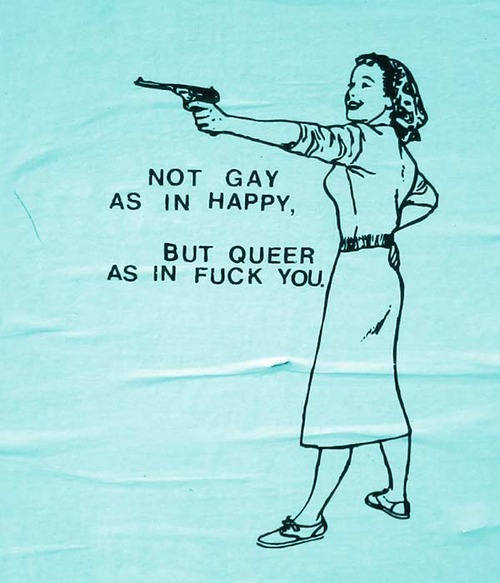
Not gay as in happy, but queer as in fuck you.

Question sexuality. Question your sexuality. Question ideas of romance and attraction. Even if you're sure you're straight, there's always room for questioning. What does that mean to you? Where do you draw that line? What is gender or sex and why do you base your sexuality on the gender of your partner instead of other characteristics that make them such an awesome person? Do you differentiate between romantic vs sexual feelings and how does that affect your perception of self?

Second, I come out because I'm in a safe and secure place to come out. I'm supported. I'm in a loving relationship. I don't experience a constant threat of violence because of my sexuality.

There's a lot of radical queer reaction to National Coming Out Day as a compulsory outing where it's found problematic that there's this perception that if you're lesbian or gay or queer and don't come out you're a shame to the community. And I agree. That kind of thinking is wrong. Because even if you stay in the closet, you're just as queer as anyone else. Come out when and to who you want to. If that means only the one confidant you trust, the whole world, or anonymous strangers on the internet, that's your choice and that's valid. And if anyone outs you without your consent, please give them hell (and take this as a warning not to do so).

We have a huge infrastructure problem for queer folk in most of the world. Addiction centers and homeless shelters and most schools aren't equipped to handle the unique pressures and challenges faced by LGBT people. There are places where you can get fired for no reason. And other places where you can't look/act gay without threat of physical violence. Throw in racial diversity or disability or refusal to comply with gender norms and I'm sure you can see how much of a struggle it can be just to exist. It's a dangerous world out there if you're too far from socially designated "normal." For a lot of people there are more pressing concerns than being out. Being out and being a role model is good and all, but collectively we've got a lot of work ahead of us.

National Coming Out Day is like the Hallmark version of Valentine's Day but put on by Big Gay Inc. It's mostly for show, gives extra treats to those who can afford it and leaves some people out in the dust. But there is good that can come of it and that's what I want to focus on here.

Third (they always have to come in threes), I can come out because I have the privilege of support to make it safe to do so, and by making myself more visible, I'm inviting anyone reading this to contact me. Ask questions. Use me as a sounding board for your own exploration. I might not have all your answers and I can't tell you what/who you are, but during undergrad I worked in offices called the Queer Resource Center (formerly the Lesbian Gay Bisexual Transgender Alliance), Sexual Awareness Center and the Women's Center, I've probably heard or read something similar before. I have access to resources, I know people, and at the very least I might be able to rephrase your question to help you get the kind of answers you're looking for. If you worry your question is offensive, I'll tell you why but I'll do my best to answer anyway. No judgments and confidential.

That's what I meant when I said "like the truth, we're out there."

Unless you've deliberately cut them out of your life and are vitriolically anti-LGBT (in which case congrats on finding this post and reading this far hopefully something I've said has pushed you to reconsider), you know queer people. Statistically it's true, but also you don't know the sexuality of the people around you (remember that heteronormativity I mentioned?). Just because a man and a woman are in a relationship doesn't mean either or both of them are straight. Bi- and pansexuality aren't nullified by relationship status.

They might be in the closet. They might be out to everyone except you. They might not be out to you because it hasn't come up yet. They might be flaming rainbow colors and because you've never been exposed to queer communities you have no references to identify clear and intentional signifiers that this person is anything but straight (yes, this happens, and full disclosure, when queer people hang out we do discuss the artful obliviousness of the straight people we're made to interact with because of school or work because the logical leaps a person will make to ignore the fact that a queer person is frothing rainbows and anti-assimilationist theory right in front of them are the stuff that queers stand-up is made of).

I'm not coming out for me. Some people do and find empowerment in owning their sexuality. Good for them. I'm coming out for the questioning kid sitting quietly in the front row to fly under the radar, for my straight friends whose minds are currently in process of being blown. I'm coming out because there's way more in this world than most of us care to explore.

Friday, December 23, 2011

Gender Label

There were probably a few things I missed... but here's a selection:

Hello
My gender is
ALWAYS!, active, activist, ally, anarchist, artsy, beautiful, bi-romantic, bitch, bottom, boy, boy in a skirt, brother, bubbly, caring, child, complex, counselor, creative, cuddly, curious, dog, dork, dude, dunno yet, etc., extrovert, eyeliner fag, fairy, feline, feminist, free, friend, friendly, gay, gay-friendly, gender bender, gender blender, gender fluid, glittery, human, indecisive, intelligent, LGBTQ, LGBTQA, LGBTQIOPPS, leftist, lover, loving, male-bodied, male-born, man, me, metrosexual, multifacetted, odd, open, passionate, philosopher, pomosexual, prettyboy, privileged, pro-sex feminist, queer, queer liberationist, quirky, right-brained, romantic, sassy, sensitive, sex positive, sexy, sissy, slut, snuggly, spiritual, student, sweet, trustworthy, understanding, whore, wife, XY
What's yours?

Sunday, May 1, 2011

Danny, tell me about the word "queer"

I'm not trying to be too in-depth with this piece so while I encourage you knowledgeable-types to make factual corrections, please don't quibble over every minor detail I got wrong. If you'd like to read a slightly better researched piece, go here.

That said, let's start at the beginning. There's the obvious origins of the word queer as a synonym for weird, strange, peculiar that because they were seen as such, was then applied to gays, lesbians, ad nauseum. In a lot of areas it has as much vehemence as the word "faggot."

Then around I want to say primarily the late-1980s with some of the bigger pro-gay movements, people started to reclaim it.


Nowadays it's used by more radically liberal activist and academic types as this really weird construction where it is used as a umbrella term. By that, I mean that queer is used to denote the entire LGBTQetc community. But these very same liberal activist/academics also often have a LOT of problems with that use since it kind of homogenizes the community. By having one word mean everything you erase the connotations and diversity inherent to such a community. There's more than one type of queer person. Queer used in that way tends to favor images of your standard college-educated, white, middle-class, gay male. Leaving out all those other types of queers.

An even more contemporary usage of the weird queer comes from the more radical academic-types as meaning something closer to "a non-normative political identity."


Basically what this means is that by this definition being queer isn't so much a sexual identity as a political affiliation. It's an outcrop of the postmodern rejection of binaries, be they gender, racial, sexual, etc. Queer in that sense tries to look at the intersectionality of those identity politics to kind of go "hey, that way of thinking is stupid and marginalizes a lot of people and doesn't really benefit everyone long run."

Which is why you find queer as a far more accepted term by younger, West coast (for lack of a better term) queers. Because we didn't grow up with queer as such a strongly derogatory term. We grew up in a world of Queer as Folk and Queer Eye for the Straight Guy.

Here at Western, the LGBTA (Lesbian Gay Bisexual Transgender Alliance) Office recently changed its name to the Queer Resource Center. And there was the same kind of split on this decision as you see among most of the LGBTQ population. There are those (myself among them) who were for the decision. Queer Resource Center more accurately reflects what the office is and does. I still have issues with queer used as an umbrella term here, but I think the strength of the Bellingham queer community in particular is that enough of the people who claim the term as an identity come from a diverse range of backgrounds that disavow a lot of the marginalizing effect of that queer homogenization.

We queers are feminists, male and female, people of color, people with disabilities, of a variety of socioeconomic backgrounds. For the most part we recognize where queer comes from (both good and bad) and often claim it as something beyond just the LGBT.

What do you think about reclaiming words? What do you think we can reclaim or can't reclaim?

Tuesday, February 22, 2011

Queer Body Issues.

A friend asked me to write up a short piece for a zine they're making on Body Image in the LGBTQ community so I thought I'd post here as well. This will likely remain a work in progress for a few days.

Growing up, the remnants of the anti-drug movement of the nineties taught me that my body is my temple. I internalized this like so many of those early messages, but reshaped it and adapted it for my own use as I grew up. I'm also queer, which means growing up my body has been subject to a range of external pressures telling it to be perfect through various media (mis)portrayals since junior high onward.

I suppose I could tell you how since starting college I've lost weight, that more and more I find that I fit the stereotypical "twink" body-type: smaller, relatively hairless, more cute than hot, more harmless than imposing. And I could let you assume that there's a correlation, that it was a conscious decision to fit this mold, but that would be a lie. I started losing weight because I got involved, started living what the health world calls an active lifestyle. I found things that I'm passionate about and I've yet to let my metabolism (or eating habits) catch up. But now I'm faced with a different kind of dilemma: the image my body projects doesn't necessarily reflect who I am.

And I dislike the box my body is forced into, it tickles the back of my mind like a badly made woolen sweater. I know I'm being judged. My body image issues aren't between me and my body, they're between everyone else and my body. Well, my body is my temple, subject to change, open for business on a whim. I'm not some twink, I reject this assumption because I would be just as awesome no matter my size or shape.

To quote that infernally popular John Mayer song, "I'm bigger than my body gives me credit for." The more I'm immersed in the queer community, that sex-positive, open-communication, radical activist side of the LGBT spectrum, the more this is reinforced because we're taught that everything is culturally encoded, everything is socially filtered and policed for acceptability so you can either change yourself or change your surroundings. I'm lucky, I'm able to do the latter and find a culture that accepts and celebrates me.

Sunday, October 10, 2010

On National Coming Out Day

For my Facebook status, I copied and pasted the following as part of showing my support for National Coming Out Day (October 11):

"I'm queer. And National Coming Out Day is tomorrow. I'm coming out for lesbian, gay, bisexual, and transgender equality because it's 2010 and almost 90% of LGBT youth experience harassment in school, and too many lives have been lost. Donate your status and join me."

Though really, what is out? Do I need to say I'm gay to prove that I'm out?

Really, haven't I been so for years? Perhaps then it is better to live a queer life, unapologetically and prove to these youth that being queer and being strong is possible. Prove to them that it's something you can celebrate and live with joy.

Being queer isn't always torture because you grow with it, grow into it. In accepting yourself and forgetting what anyone else could say, what they do say (and they will say many things), you become something else, something stronger. What doesn't kill you makes you stronger, right? So don't let it kill you. You have to make it your resolve to be better for it.


But at the same time, I have to recognize that I'm speaking about this from a place of privilege. Despite identifying as a queer person of color (color being loosely defined by an unknown mix of genetics to give me that off-white olive tone when I get enough sun), I can pass as a straight, white male.

I've never tried to pass, and so my identity has never been called into question. I'm queer. Period. Out of time, save your questions for another day. So in a sense I've never come out. What does it mean that we live in an age where there are people who can live vicarious, actively gay lives and never come out and actually say they're gay?

I'm lucky. I was never bullied, never harassed. Which is why it's all the more important for me to take part in these kinds of queer movements, to show that it is possible and make it more possible for others to have the kind of experience I did where being queer wasn't a struggle, where it was a personal norm (even if still not a societal one).

There's this mythology that coming out has to be a drama, a tragedy. And yes, it will always be a struggle to find yourself and figure out who you are and what you want and love that for all that it is, but I think that happens whether you're queer or not. It's my mission to help make a world that breaks this myth, turns it on its head and questions proudly, "What do you mean by out?"

Monday, October 4, 2010

On recent gay teen suicides

I've been relatively disconnected from a lot of the queer community the last few weeks, my information systems are down since I'm so busy working on other relevant causes in my area.

Partly motivated by the prospect of Mallard's ice cream, partly by the fact that everyone in the QPOC (Queer People of Color) meeting I'd just attended were going and partly by a desire to be more social in the WWU queer community, I went to the LGBTA Ice Cream Social on campus Thursday.

I saw people I knew, people I didn't know. I ended up volunteering myself to run the button making table because I know how to work the button machines. So I failed miserably at the social part, but I've just accepted that as the way my life works. You go places and you become a part of whatever you go to, the sociality is the action of being involved. My roommate will tell you it's me being a yes man, but I disagree. What authority do I submit to by stepping up?

In the wake of 6 suicides nationally by gay teens, happening just on the periphery of what I know is going on in the world, I find it especially heartening that Western has such a vibrant, diverse and open presence for the LGBTQ community. TRANSport, QAAFA (Queers and Allies for Activism), QPOC to name but a few closer to campus. I can take off the rose tinted glasses long enough to recognize that there are problems, it isn't perfect, Western and Bellingham have work to do to take meaningful steps towards true queer inclusiveness, but compared to a lot of places, we have resources.

So even though I have plenty of other things on my plate, I've decided to apply for an internship in the LGBTA offices. I don't know if I'll get the position, and I'm sure even if I don't I'll be involved in some way, but this is a step for me, taking ownership of part of this identity I create and showing exactly how much of an impact I can have by being the queer I am.


I'll edit and post my own video when I get around to making one. But it gets better.

I'm not going to list them here, because I believe that if you're reading this, you probably already care enough to have already looked up resources online. And there are resources out there.

Wednesday, December 9, 2009

Queer Tarot: A Final Project


Tarot, like Mark Doty’s Ouija board, in Western culture is seen as a part of the occult. It is relegated to the fringes of society, the dark corners of psychic shops, late night television and gypsy houses, seen from a distance but rarely ever sold. But at the same time, it has been around for centuries, used historically as a divination tool and card game, and in more recent years has gained a wider acceptance into mainstream culture. Walk into any Borders, and you can find and purchase a deck of tarot for under $30. The same can be said of queer and gay culture and identity.

The deck I’ve created is meant to reflect some of those parallels, drawing on the traditional meanings of the cards and prominent images from within queer culture to make new meanings based in part within GLBT theory.


Tradition states that the Fool, sometimes numbered 0, sometimes numbered infinity, is the card of infinite possibilities. It is a card of the future, of new beginnings. Here we have a card that depicts not a lone traveler standing on the edge of a precipice, but an activist, faceless and alone. The Fool here wears traditionally masculine clothing and appears to have short cropped hair, but because of the facelessness, defies the gender binary. Possibilities are indeed open as the activist hopes for the future and endeavors to bring it forward. Equality, safety, family, all the hallmarks of the gay civil rights movements can be represented by the simple rainbow sign, but the card is still the Fool. A movement is not one person. Change will not happen because one person, alone, stands on a street corner and yells to passerby. But one person can start a movement; just like how Galloway in Mean Little Deaf Queer defied her own limitations and went on to create from within herself a life worth telling about.


The Empress in this deck is a Queen, specifically an image of RuPaul from a promotional photo for RuPaul’s Drag Race, and what better way to queer-up what is seen as the mother card of Tarot than to express it as the extreme feminine that is simultaneously everything masculine? In this card we can see the dualities of identity. As a drag queen, RuPaul represents everything about the Empress, that spark of creation and performance in art and life, gender as a performance as Butler worded it. As the antipode of traditional femininity though, she evokes a certain level of acceptance and almost tongue-in-cheek playfulness to the idea of gender. The role of queen, empress, and mother is not limited to the female, but is instead an inherent trait available to all peoples, showing that the idea of essentialism, that there is only one kind of Empress, does not hold true in the face of drag. It is proof that there can be aspects of the mother in all of us.

A wedding topper marks the Lovers in this queer tarot deck. In many traditions of tarot, this card is known simply as Love because love is seen as a force of decision and control. You surrender to a higher power when you submit to love and are forced to make decisions that you might not make otherwise. Celie, of Alice Walker’s The Color Purple, submitted to love and she found her strength through it. It is this idea of love that so strongly resonates within the queer community because it has been a rallying point around which to draw those battle lines that the activists (the Fools) can work to create the kinds of change the Empress represents. And in recent history, the biggest rallying point of the queer community has been this idea of gay marriage. On another level too, marriage marks a decision as you choose to make those vows and give up or adjust your lifestyle. And for that matter, the decision to allow/not allow gay marriage or the decision to get one are both cultural creations. We are not born married, but through the constructions of our society we are indoctrinated to believe that it is something we want. The cultural imperative to marry is so embedded that social and political structures have grown up around it. Taken in that sense, this card can serve as a warning against the very image it so innocently projects. Marriage is not natural any more than these wedding toppers are actual people or actual food.


Rather than the Hanged Man, the next card we find is a Well-hung Man dangling in similar position to the traditional card his black leather chaps, thong and chest-belt showing him to be something a little more than your average queer but as someone from the further marginalized spectrum of sadomasochistic inclinations. He is a visual example of Rubin’s sexual hierarchy. For his preference for bondage, he has been strung up and left to dangle, which for all its irony perfectly shows the meaning of the original Hanged Man, the idea that in suspension of thought, in meditation and reflection we find new perspectives that can lead to insight. Within other aspects of what it means to be queer, beyond the gender binary, beyond the heteronormative constructions that have homogenized and isolated the queer community to being ruled by a class of white, middle-class gay men, we find sub-queers that can live perfectly happy, productive lives and are indeed no threat to society but a part of it.


For the final card, we have Death, the unnamed skeletal creature that walks with its sickle, portending doom. But just as Mark Doty did in his discussion of AIDS in My Alexandria, Death is not a thing to be afraid of. It gets a bad rap from pop culture and society, but it is a tool of transformation and change part of the cycle of renewal. An end is but a new beginning, for spring cannot bloom if not first for the fallow wastes of winter. There is beauty in the act of passing. And so in this queered tarot we find a frail, skeletal looking woman admiring a bright, vibrant flower, freshly bloomed. The Fool then is an agent of Death, working to end the cultural stigmas around the queer identity and bring about a new world as the minority works to be recognized and integrated into the acceptance taken for granted by the majority.


Friday, November 20, 2009

The difference between being gay and *being* gay

Being gay is either something you’re born with or it’s a choice. It came up in the movies we watched repeatedly as a way of both reinforcing that separatist view, that in order to create a safe place for a gay identity, you must first establish that to be gay is something separate, something different from the normal in order to gain special protections and rights.

In "Mean Little Deaf Queer", I think Galloway puts it very succinctly when she states that it’s a matter of us and “them.” She’s mostly relating to her experience as being disabled/handicapped, but there are direct parallels between that simple statement and the ideology that being queer is something you’re born with or a choice. Like the little deaf queer that she was Galloway chose neither to be gay nor to be deaf. What she did choose was to live with those conditions on her life and push through them.

Queerness is not something people choose. I don’t know of any straight person who would choose to live their life as a gay/lesbian/bi/trans person if they weren’t. But if being queer is something that is innate, that you are born with it, then to go back to Gayle Rubin’s constructivist views, how you choose to live that life, how you express that sexuality or gender identity is a product of your upbringing.

In an upbringing that believes that being queer is somehow wrong, to be gay or rather I should say to live a gay lifestyle then must become a choice. Who you are constructed to be and what you are as a result of that does not allow for a gay identity so to have a gay identity is to choose not to be what you were born to in favor of being what you were born. To become what you were born and accept that is a choice.

So, is being gay something you’re born with or is it a choice? It depends on what you mean by being gay. It is at this junction that the religious institution and the queer community often reach an impasse because they both mean very different things and have very different views on this matter.

They equate being gay to living a gay lifestyle and accepting yourself as gay. These are not the same thing. Identity is a personal matter, and to call a thing an identity when a person does not identify as such is an assumption that devalues the identity of that person.