Widdershins:

(sometimes withershins, widershins or widderschynnes) means to take a course opposite that of the sun, going counterclock-wise, lefthandwise, or to circle an object, by always keeping it on the left. It also means "in a direction opposite to the usual," which is how I choose to take it in using it as the title of this blog. We're all in the same world finding our own way.

Friday, August 19, 2016

Plane Tickets, Poetry and Me

Hello friends,

So as most of you hopefully know by now, I'm living on the East Coast. The summers are humid and miserable. The winters are biting and cold. Autumn is absolutely gorgeous for like two week. Spring is... nothing to write home about, I guess.

It's pretty good overall. I got a job at a dining hall within a month of moving here. I finally earned my honarary-Bagelry employee status by becoming a baker at the local equivalent a few months later. I've met some amazing people and seen some pretty cool stuff.

A photo posted by Danny (@acelessthan3) on

Not going to lie, it was tough for a little bit there. Ethan and I spent a good three months sleeping on a slowly failing air mattress until we got our taxes done and I bought a futon.

Still haven't managed to see an Atlantic sunrise, but there's still plenty of time for that.

At the same time, I miss my BellingHome and the familiar coastal grey of the PNW. I even got a tattoo of a Douglas Fir pinecone to remind me of my roots.

A photo posted by Danny (@acelessthan3) on


But after a year, it's time to go home at least for a visit. I know my mom could probably use the hug.

Right now plans are to fly out sometime in the first half of January when my dining hall job is on winter break and while I'm already starting to save up what I can, I'm just going to put it out there that if anyone would like to help, you can send me money via paypal here: paypal.me/acelessthan3

I'm also starting to apply to grad schools because I still like the idea of actually doing physical therapy (gotta get them letters after my name, yo) and like that whole process is expensive.

But I refuse ask for money for nothing. So if you send me at least $2, message me a mailing address (text, Facebook, other miscellaneous social media) and I'll send you a copy of a poem. And if you send $10 or more, I'll write a poem just for you.

Again, that's paypal.me/acelessthan3 send me money and I'll send you poetry and together we'll send me back to the shadows of dormant volcanoes.


Saturday, May 28, 2016

High Fiber Diet

So if you know me for long enough, you'll learn that I'm obsessed with fiber. It is, after all, essential to a well-balanced diet and healthy poops. My former roommate David can attest that I would frequently play games of "Where can Danny hide the fiber?" when making dinner for myself and Ethan. Blame it on an anal fixation (thanks Freud) and the results of volunteering in the endoscopy department of a hospital for a year and a half (thanks to the good people of Skagit Regional Hospital). So let me bestow on you all kinds of knowledge you never wanted to know about fiber. But first, a poem:

An Organic Grocer Haiku

Chia seeds, flax seeds
Hemp, sesame, pumpkin seeds
What are we now, birds?

What is fiber?

Fiber. You know, fiber. It's the stuff in the Cheerios commercial. The thing the little kid reads will help lower your cholesterol. It's in oats and vegetables and stuff. But what is it?

Dietary fiber, is a substance in plants, a type of carbohydrate that the human body can't digest into smaller sugars. It comes in two types classified on their ability to dissolve-in or absorb water. Soluble fiber dissolves in water. Insoluble doesn't. There's also what's called functional fiber that's all the manufactured versions and chemically isolated types of soluble and insoluble fiber. Which is just one of many ways scientists have found to classify types of fiber over the years.

To keep things simple, I'll use the idea that soluble fiber slows digestion and insoluble moves things along.

Ew poop!

You can't talk about fiber without inevitably bringing up a number two. 

You probably know how prune juice is supposed to reduce your chances of constipation. But have you ever read the nutritional label to see how much fiber is in it? Three grams of fiber (depending on the size of the cup). Compare that to the three grams in your standard microwave packet of oatmeal and you'll quickly realize that's a good amount.

Soluble and insoluble fiber are both good for you in different ways. When the Cheerios commercial says it helps lower bad cholesterol, it means they're high in soluble fiber such as the kind found in the oats that Cheerios are made out of.  Soluble fiber is also the kind of fiber that helps control your blood sugar levels. They're also highly fermentable which means the "good" bacteria that live in the human intestinal tract can digest it. They help you digest it so you can absorb more nutrients. It's the insoluble fiber though that keeps you regular. 

What's good for your poop is good for you

For over a year I volunteered once a week in the endoscopy department of a hospital. If you don't know what an endocopy is, it's where they take a flexible camera and (gently) rotor rooter it through your colon to see if everything's going okay (colonscopy) or down your throat into your stomach (upper endoscopy). Don't worry, they get thoroughly sanitized between uses. If the thought of either causes you to clench or activates your gag reflex, they almost always put you out with mild anesthesia before you go under.  The nurses were friendly and funny, the patients occasionally a little loopy. I learned a lot. For example, the procedure is covered by most insurance companies as an investigative procedure to look at symptoms but not necessarily as a screening procedure (like is recommended for anyone over 50)*. 

I also heard a lot of diagnoses. Everything from hemorrhoids and ulcers to diverticulitis (inflammation of diverticuli or small pockets in the intestinal wall caused by weakening of the muscles lining your intestine, common with age) and colorectal polyps. And the number one phrase I heard to help treat most of these: "high fiber diet."* 

Soluble fiber makes your stool softer and insoluble fiber helps bulk it up, which together make for solid, easy poops. No straining. No constipation. A quicker, cleaner toilet operation all around.

*as I am not a certified medical professional or insurance agent, always check with your individual healthcare and insurance providers to determine your symptoms, treatment, and what is and isn't covered.

Sources and supplementation

Diet

Oats, beans, whole wheat, vegetables, fruit, nut and seeds are all good sources of fiber. Obviously this is the number one nutritionist and doctor supported ideal. By eating whole foods you're getting all the vitamins, minerals and other nutrients with your fiber. It's variety and color and not the meat-paired-with-processed-white typical of a Standard American Diet. 

There have been studies recently looking at the differences between people in remote hunter-gatherer societies' diets and people from industrialized nations and the most significant differences have been in fiber intake. Given how this feeds and changes the microbiome of your intestinal tract, you'd think there'd be a bigger push to get people eating their fiber. 

Supplements

Not everybody eats the perfect diet all the time and maybe even if you are eating plenty of vegetables and whatnot you're still falling short of the clinically recommended 30-35g daily (38g for men). That's where supplements come in.

Most supplements are some form of psyllium husk or powder. Think Metamucil or Benefiber brands. They can be a little gritty and if you don't drink it fast enough can clump up in your glass. They're easy to make, convenient to mix into your regular drinks, and fairly cheap for how much you get.

Whole food supplements

Supplements don't have to be just fiber though. There are actually plenty of whole foods that are packed with fiber (and other vitamins, minerals and other nutrients). My favorite are flaxseed and chia seeds, they're called superfoods by all the magazines for a reason. They're packed with fiber, vitamins, minerals, protein along with omega-3 fatty acids all for a fairly moderate amount. I put a small handful (this is a very precise measuring method equal to about two tablespoons) of flaxseed in my daily breakfast smoothie (I have one of those NutriBullets, the Magic Bullet 2.0 and it blends ANYTHING) and sometimes mix chia seeds with hemp milk to sit overnight almost like a vegan pudding (a little sugar, maybe some matcha powder if I have it).

Benefits

Fiber and poop aren't exactly the most fun things to talk about. I get it. And preventing slow-acting diseases and ailments of the body is by no means sexy (unless you think being healthy is sexy in which case, mmm, gimme that thick carrot).

A lot of anecdotal evidence (and personal experience) says that higher fiber intake leads to increased sense of fullness. With flaxseed, whole frozen fruits and vegetables and sometimes added pumpkin and chia seed in the mix, my breakfast smoothies usually clock in at about 30-40% of my RDV fiber in one sitting and I'm usually good afterward until at least lunch time. So if you're trying to lose weight, adding more fiber can be one of those dietary changes you make to get yourself to eat less (or at least differently).

I heard it on Oprah once, but where the fiber goes, water goes. Think of it this way: dietary fiber is essentially little bits of plant sponge and if you have them dried out, they'll suck as much water out of your gut as they can. Since so many of us are bordering on mildly dehydrated to begin with, you can see how this might be a problem. As I've increased my fiber intake, I've also vastly increased my water intake to match and I feel better and more hydrated for it.

tl;dr fiber is good for you, eat more fiber-rich food.

Tuesday, May 17, 2016

Every Time We Touch

I have a confession to make:

I am terrified of physical intimacy with other men. But at the same time, I crave it. When I want to feel physically comforted, my first instinct/desire is to want it from the men in my life (even though I'm much more likely to be readily supported and listened to by the women who love me).

I'm slowly realizing that growing up queer in a homophobic, hetero-patriarchal world kind of fucked me up more than I like to admit and as a result I have underlying insecurities around any kind of physical intimacy with men who I am not romantically or sexually involved with.

Participating in a Free Hugs
and (Hershey's) Kisses event
in undergrad
And you may be thinking to yourself, Danny, you're queer. You've been with the same partner for four years in a stable, healthy relationship, you offer hugs and are super touchy and gentle and vulnerable with people all the time.

To which I must say, you're right, I am physically and emotionally intimate with people all the time.

Actually being intimate and being afraid of intimacy are not mutually exclusive.

I would argue that my fear (though maybe deep-seated anxiety is a better phrasing) is not innate, but rather a manifestation of a culturally ingrained stigma born out of societal homophobia. It's learned. Before you read on, I encourage you to check out this article by Mark Greene on the Goodmenproject about what he calls touch isolation and how homophobia creates a culture wherein men aren't allowed to touch each other.

My willingness to be intimate with other men is also learned: by exposing myself to an inclusive, diverse arts community, by being actively queer, basically I have expanded my comfort zone by existing at and interacting with the margins of society where the strict boundaries of "normal" behavior are blurred.

If I'm insecure or anxious, it is because society has taught me that I should only be allowed that physical intimacy, that closeness, in certain kinds of relationships. The underlying fear can best be encapsulated by the question: will this be conceived as sexual contact? It's the internalized conflict between a hypersexualized gay culture (all contact between two men is or will become sexual) and certain aspects of homophobic cultural conditioning (contact between two men should never be sexual) with the reality that not all touch is inherently sexualized and even if it is, that's not always a bad thing.

 Even within my own personal experience this isn't universally true. After all, I'm a notorious cuddler with close friends. Pet me. Hug me. Trade massages. Brush my head with your elbow. Touch is very important to my life.

My head being brushed with an elbow.
I've been actively unlearning this social conditioning for years now, but sometimes it still catches me off guard. It's compounded by the specific ways in which as a queer man I have to unravel and separate the various forms of attraction, desire, lust, like, and love that I can feel for any given man at any given time, and usually there's more than one happening at the same time. This isn't always an easy task.

So is a hug just a hug or is it a hug?

It depends. Sometimes it's both.

What I'm trying to unpack here is that I don't think physical intimacy is something to be afraid of. We can touch, hug, cuddle, kiss, whatever and it doesn't have to be a Thing. It can just be the base comfort of sharing space and company. I want that for myself. I want that for you.  Otherwise we are depriving ourselves for nothing.

And to the men in my life that I can be vulnerable with, where the hugs last just long enough to make the occasional person watching uncomfortable, who will hold my hand while we sit in silence, those shoulders to lean on even when I don't need support, know I appreciate you. You're helping me overcome a lifetime of deprivation.

As a endnote to this post, I would like to address the role of consent in these interactions. All too frequently we talk about consent in terms of sex, but part of recognizing and honoring the body autonomy of the people we interact with is by establishing boundaries and communicating. Some people aren't okay with touch. So ask. Can I hug you? Want to cuddle?

Offer alternatives. Hand-hug instead of full body hug. Sit next to each other instead of on each other.

Meet people where they're at. Men especially in our culture can take some time to warm up to the idea of body contact that isn't explicitly sexual or aggressively nonsexual (sports/roughhousing), but give them the option. Create space and opportunities to be close, but with the option to opt out if it's too much.

Tuesday, May 10, 2016

What Are You? A Personal Intersection of Race, Identity and Queerness

"So... What are you?"

It's an innocuous enough question in most circumstances, awkwardly phrased with downturned eyes, like the person asking doesn't know if they're allowed to ask. Sometimes it's worded differently: "What's your ethnicity?" or "Where are you from?"

If you're not white and living in the United States, you're familiar with this song and dance. You may even get it often enough to be annoyed, perhaps even offended. It is, after all, one of those microaggressions continually reminding you of your non-whiteness, branding you as Other. You are not white, therefore you are not really of here. However innocent, it's an interrogation based in our American cultural obsessions with race and identity.

But this post is only partly about that. Call this post a confession and an answer. See, I struggle to answer these questions.

I was raised just outside a small city in Washington called Puyallup. It was the suburbs; a pleasant - if homogenously bland - existence where everyone needed a car to get around. The area was mostly white and grew dramatically through my childhood and adolescence with the housing boom of the late-nineties and early-noughts.

My parents both grew up in West Seattle. My mother raised by an immigrant who gave me her dimples, my father by the kind of straight-laced couple who have lived in the same house for decades, who seem more a part of the landscape than the characters passing through.

A week after I graduated high school, my mom pulled me aside.

Russell isn't your father, she told me. Your brother is actually your half-brother. Your biological father is actually a man named Joseph.

It was a shock, but not world shattering. Call it the weary resilience of a child of divorce combined with the stability that comes from a strong sense of community and selfhood. I carry the name of my father but do not share his blood.

"So... What are you?"

Well, through my mom I'm a quarter Japanese and a quarter German-American. On my dad's side... I don't know.

I'm clearly not white. I'm what a self-aware sitcom might jokingly refer to as "vaguely ethnic." I have olive skin that ripens under the summer sun into a glowing brown. My eyes slant just enough to give me away. I could be mixed Hispanic, or maybe Philipino, or Persian. I'm a mutt of indeterminate origin, the beautiful bowl of soup poured straight from the melting pot. I'm the beige future that racist white folk whisper about in fear when discussing interracial relationships.

Here's an excellent study in contrast of me dancing with my friend Gabe.

I've seen pictures of my biological father. Volunteered to me without request, but have never had an interest in seeking out contact. Who would this stranger with his own family and life be to me? What would I be to him, an adult son with a life already his own?

I don't need another father.

Still, it leaves me at an impasse. I do not know my roots. I do not have a tidy little pedigree to present on command. I am mixed unknown, American as individually-wrapped sliced cheese product.

As a result, like many mixed race kids, I've rarely felt like I belong -- at least when it comes to matters of race. Despite my upbringing, I've never been white. The social studies teacher in junior high who tried to call me Mr. Miyagi more than proved that point. If I'm curious, I could always do one of those genealogy tests. Swab my mouth and send it to a lab, receive a chart and map in the mail. But without a connection to culture, I've never felt comfortable partaking in many of the social safe spaces for my POC peers (welcoming as they may be).

I’ve studied the language and history and culture of my maternal grandmother and even visited Japan once long ago, but as much as I ache for cherry blossoms in the spring, I will always be a foreigner.

It took a trip to Boston to finally see my first spring sakura in New England.


And I guess this is all a part of what makes me queer, really.

LGBTQ-folk in America have a long narrative history of the “adopted” or “chosen” family because so many of us are still getting disowned and cast out by our birth families. So we surround ourselves with people who will love and support us.

I have my birth family: My mother and brother and step-father who I don’t call as often as I should. My partner’s amazing extended family who are so happy to see that I make him happy.

I also have my chosen families: My Charlie-sis who took me to my first concerts and dragged me to my first dance lesson. The expansive Power of Hope community that has nurtured my heArtistry for years. All the Poets who stare at the moon. My QTs (Meow). And everyone else who holds me accountable and pushes me to grow and love.

I have a tattoo of the symbol for mercury on my right forearm.

It’s there as a reminder of my own liminality, that someone has to fill in the blanks, read between the lines, exist in spaces between. Despite what American misconceptions may force on me, I am more than my race. I am more than my skin tone. You don’t need to know what I am to know who I am.

Friday, November 13, 2015

A Millenial's Guide to Technology

If you're reading this post, congratulations!

You've managed to turn on a computer, connect it to the internet through either a ethernet cable or wifi, open a browser and through either clicking on a Facebook link or clicking a link on a Google search.

If you're saying to yourself, "Yeah, Admiral Obvious, get to the point." Then this post probably isn't for you.

If you're wondering what a browser is, then please, read on.

This post is by no means comprehensive, it probably won't tell you what to do to fix your specific problem, but if you read on you might learn the methods you can use to

Chances are you're the parent or grandparent of a Millennial or Gen Z (iGen, post-Millennial, whatever). They're the 10-30 year old offspring you turn to when you have a computer problem, and they get frustrated. They roll their eyes and act like you've asked them the stupidest question in the world when you tell them your internet won't work and can they please come fix it even though they live three hours away (love you mom).

Still wondering what a browser is? It's a program on your computer that connects you to the internet. You might know it better as Firefox or Chrome or Safari or Edge or (please get help switching to ANYTHING ELSE) Internet Explorer. You might only know it as the colorful icon (small image you click on to "open the internet") that each of these programs uses.

The five most common internet browser icons.
See, it's not that we millennials think you're stupid. We think you're technologically incompetent even though you managed to print off and bring home chain emails and jokes from work years before most of us were glued to the screen. Which is okay. Technology, especially the internet variety has been changing at a very fast pace. You've probably read about it in a newspaper or heard about it on the local news (meanwhile your kids are reading blog posts on social media that make fun of the fact that you still read a physical newspaper and watch the local news even though corporate media is controlled by the 1% and frames most of what it shows in highly biased ways despite the lofty journalistic goals of objectivity).

So how do you keep up?

First and foremost you have to be willing to experiment. If your kid is fixing your computer for you, unless you've done something devastatingly wrong like wipe the entire contents of your hardrive (which how you could do that on accident is beyond me), they're probably just clicking around randomly until they find something that looks like it might be working. 

It just looks like computer magic because their reflexes are a lot faster than yours. Most of us can tell if clicking on something helped within two seconds. That's why when your wonder child is at work windows (the screens on your monitor, a.k.a. the part of the computer you look at) seem to pop up and disappear before you get a chance to look at them.

Second (if you're connected to the internet), Google is your friend. Or at least your merciful Search Overlord. 

You've used Google. You've probably even used Bing and Yahoo or even Ask back in the day. They're search engines that look at everything on the internet for pages relevant to whatever search terms you've entered. Technically when someone tells you to "Google something" they mean "Use the Google webpage to search something" or sometimes just "look something up on the internet" (though Google doesn't like the latter so much).

But sometimes Google doesn't give you what you want. 

Pop quiz!

You hear a song you like on the radio and the DJ doesn't mention the name or the artist so when you get home you decide to Google it. What do you put into the search bar?

If you answered something along the lines of "What is the name of the ______ song?" or "Who sings the ________ song?" You're not searching like a millennial.

You see, most search engines are what's called keyword-based searches. You put in the most important/relevant information and it searches the internet for those keywords and ranks them by whatever system that site uses. Asking questions like the above are what's called natural language searches because they sound like natural language. You're asking the same way you would ask your friend Susan.

A millennial would take the a few words from the chorus of the song and add the word lyrics to the end of the search. 

Compare the search results you get from "If your love was a broken stereo lyrics" to "Who sings the broken stereo song?" Completely different. And if you're looking for the Sean Fournier song, one will get you better results.

This means of course that in order to troubleshoot your computer problems you'll have more success if you search like a millennial. How do you get the results you want?

You have to know what your problem is and if you don't know, make an educated guess. Is it a hardware or software problem (is it a thing you use to work the computer not working like your mouse or keyboard or a program you've installed on your computer)? Are you on a touchscreen device or a computer/laptop? Is there an error message?

Error messages, even though they're telling you something is wrong are a huge help toward fixing your problem. If you can, never close (x out of) an error message until you've written down what the error message says. They usually tell you what's wrong or have something like "Error x300n9" that you can Google. Because if you have an error, guaranteed someone else on the internet has had that same error and has either posted how they fixed it or gotten help from whatever company makes the program/computer causing the error.

Information like brand, model, version of whatever program you're having trouble with can all help you find what you're looking for. The more specific you can be about what's wrong, the more likely you are to have success. 

"Mouse won't click" is better than "mouse won't work."

Sometimes you can't look things up with Google. Maybe your internet isn't working for one of a variety of potential reasons and that's the problem you're trying to fix. 

Left to fend for yourself you have to resort back to that click until something works method. If it helps, pretend you're an archaeologist studying a dead culture's technology. Use the scientific method

If the internet is the problem, is it really the problem? You might have noticed back when I was talking about browsers that they connect you to the internet, but they aren't your connection to the internet. That's either the wireless router (wifi) or ethernet cable connecting your device to the modem (the thing plugged into the wall that you probably got from your internet provider). If you're on wireless, first ask if it's just your device having issues or all of them. That will change whether or not you try to fix your router or you computer. 

General rule of thumb, make sure everything is turned on properly. If on wireless, make sure your device is connecting to your router. You can find that either in settings or by clicking the thing on your computer that looks like some variation of this:


It's an old joke, but sometimes turning your computer off and back on again can reset whatever is causing your problem. Know where the power button is.

Lastly, and this is the most important one on here, know when something is beyond your ability to fix. I know this post is all about teaching you to be self-sufficient out in the world wide web. This is particularly true of hardware problems, unless you feel comfortable and confident in your ability to take apart your computer and replace parts without breaking anything. 

If you're on the phone with tech support (whether that be your offspring or a customer service rep) be nice, answer their questions, stay calm, if you get to a point where you think you know what you're doing, tell them if you click on or enter anything because they're probably going down a giant checklist and if you skip steps it will confuse them.

tl;dr here's a handy xkdc flowchart that you can refer to.

Much props to this post for inspiring me to write this. 

Monday, October 12, 2015

National Coming Out Day 2015: Questions, Comments, Concerns

I owe a huge debt to the women, trans folk, and people of color in my life for making me aware of these kinds of issues. Any thought relating to social justice is intersectional and relates to issues of queerness and it would be irresponsible of me not to acknowledge that up front. I think about it constantly because I'm surrounded by it and I couldn't name the dozens of sources that implicitly or explicitly influenced this post through Facebook posts, tumblr links, articles (academic or otherwise). But I wouldn't/couldn't say this without you.

I've been "out" my entire adult life.

What that means has changed and evolved over the years from the somewhat scared and questioning teenager devouring every scrap of (sometimes dubiously age-appropriate) information available at the local library to the internally raging queer questioning everything sitting at their computer writing for you today. So yesterday when I posted on Facebook for National Coming Out Day, I wasn't surprised that the majority of responses were loving and supportive. I've long since backed away from the kind of people who wouldn't love me and people like me.


But this isn't an "It Gets Better" moment.

While coming out is a continuous action, I'll save you the Gender Trouble spiel on discursive repetition and performativity. No matter how "out" you are, there will always be people and institutions too ignorant or oblivious to know without it being spelled out. That's called heteronormativity and is part of the larger cultural problem of assuming everyone we meet is straight until proven otherwise. I'm guilty of it (not as much as 10 years ago and I'm better at internally questioning that assumption, but such is the pain of the culture I was raised into).

So why come out?

First, I want to specify my use of queer as opposed to gay. I know there's still a lot of intra-community debate over the use of the term queer. Historically it has been used as a slur and a lot of people are uncomfortable with the associations that can be drawn from the archaic definition where it means weird. Those are valid reasons not to label yourself queer. As a college-educated person, I take the more postmodern route where queer is an anti-label. I'm okay with you calling me gay, but identifying myself as queer I'm saying you can never be fully sure what I mean. I could mean I'm bisexual, pansexual, aromantic homosexual or one of myriad sexual orientations that make up our beautiful alphabet soup. Complicate that with the fact that queer has also been used as an umbrella term to encapsulate the entire LGBTQAA2I+ and this too has been contested. In short:

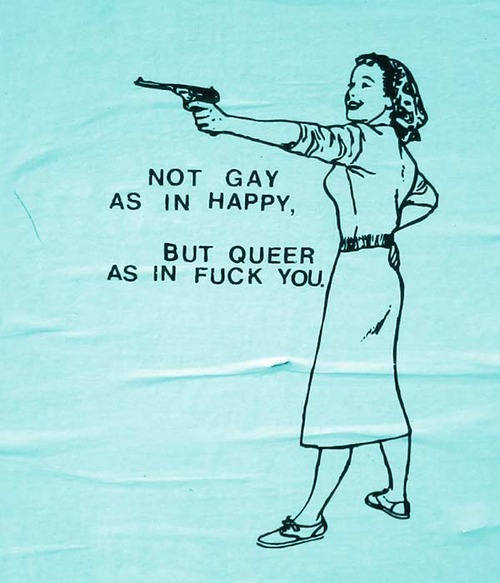
Not gay as in happy, but queer as in fuck you.

Question sexuality. Question your sexuality. Question ideas of romance and attraction. Even if you're sure you're straight, there's always room for questioning. What does that mean to you? Where do you draw that line? What is gender or sex and why do you base your sexuality on the gender of your partner instead of other characteristics that make them such an awesome person? Do you differentiate between romantic vs sexual feelings and how does that affect your perception of self?

Second, I come out because I'm in a safe and secure place to come out. I'm supported. I'm in a loving relationship. I don't experience a constant threat of violence because of my sexuality.

There's a lot of radical queer reaction to National Coming Out Day as a compulsory outing where it's found problematic that there's this perception that if you're lesbian or gay or queer and don't come out you're a shame to the community. And I agree. That kind of thinking is wrong. Because even if you stay in the closet, you're just as queer as anyone else. Come out when and to who you want to. If that means only the one confidant you trust, the whole world, or anonymous strangers on the internet, that's your choice and that's valid. And if anyone outs you without your consent, please give them hell (and take this as a warning not to do so).

We have a huge infrastructure problem for queer folk in most of the world. Addiction centers and homeless shelters and most schools aren't equipped to handle the unique pressures and challenges faced by LGBT people. There are places where you can get fired for no reason. And other places where you can't look/act gay without threat of physical violence. Throw in racial diversity or disability or refusal to comply with gender norms and I'm sure you can see how much of a struggle it can be just to exist. It's a dangerous world out there if you're too far from socially designated "normal." For a lot of people there are more pressing concerns than being out. Being out and being a role model is good and all, but collectively we've got a lot of work ahead of us.

National Coming Out Day is like the Hallmark version of Valentine's Day but put on by Big Gay Inc. It's mostly for show, gives extra treats to those who can afford it and leaves some people out in the dust. But there is good that can come of it and that's what I want to focus on here.

Third (they always have to come in threes), I can come out because I have the privilege of support to make it safe to do so, and by making myself more visible, I'm inviting anyone reading this to contact me. Ask questions. Use me as a sounding board for your own exploration. I might not have all your answers and I can't tell you what/who you are, but during undergrad I worked in offices called the Queer Resource Center (formerly the Lesbian Gay Bisexual Transgender Alliance), Sexual Awareness Center and the Women's Center, I've probably heard or read something similar before. I have access to resources, I know people, and at the very least I might be able to rephrase your question to help you get the kind of answers you're looking for. If you worry your question is offensive, I'll tell you why but I'll do my best to answer anyway. No judgments and confidential.

That's what I meant when I said "like the truth, we're out there."

Unless you've deliberately cut them out of your life and are vitriolically anti-LGBT (in which case congrats on finding this post and reading this far hopefully something I've said has pushed you to reconsider), you know queer people. Statistically it's true, but also you don't know the sexuality of the people around you (remember that heteronormativity I mentioned?). Just because a man and a woman are in a relationship doesn't mean either or both of them are straight. Bi- and pansexuality aren't nullified by relationship status.

They might be in the closet. They might be out to everyone except you. They might not be out to you because it hasn't come up yet. They might be flaming rainbow colors and because you've never been exposed to queer communities you have no references to identify clear and intentional signifiers that this person is anything but straight (yes, this happens, and full disclosure, when queer people hang out we do discuss the artful obliviousness of the straight people we're made to interact with because of school or work because the logical leaps a person will make to ignore the fact that a queer person is frothing rainbows and anti-assimilationist theory right in front of them are the stuff that queers stand-up is made of).

I'm not coming out for me. Some people do and find empowerment in owning their sexuality. Good for them. I'm coming out for the questioning kid sitting quietly in the front row to fly under the radar, for my straight friends whose minds are currently in process of being blown. I'm coming out because there's way more in this world than most of us care to explore.

Saturday, September 27, 2014

White men being violent assholes

or why I'll always pick a shitty, campy queer film over a critically-acclaimed American television drama

Look, I'm not going to hold it against you for liking things like Breaking Bad or True Detective or what have you crime drama on FX or HBO. There are lots of them and many of them are amazingly done with great storylines, beautiful cinematography, superb acting, and probably unnecessary amounts of misogyny (implicit or otherwise).

But most of them can be boiled down to one simple, five-word description: white men being violent assholes.

And I have absolutely no interest in that. It's partly the whole realistic crime drama thing, I don't care to indulge in the Great American Pastime of glorified Cops and Robbers (now in HD). But it's also definitely the violent white assholes. If you put it on for me, I'll get on my computer and pay little enough attention that I couldn't tell you more than what happened a minute ago.

It's a violent kind of apathy,  the kind where I'm sure if you had a camera pointed at me you could watch my eyes glaze over into a blank haze of disinterest. Even talking about it now, I'm struggling to express exactly how much I don't care because that means I have to fake caring enough to express it, but for you, I'll power through.

It's not just the violence, I've watched films like Lars von Trier's Antichrist and found the gritty, gore perfectly acceptable. The film wouldn't have worked without it. I was a fan of MTV's Teen Wolf until the writer's decided to kill of Allison's character when the actress decided she didn't want to continue working on a show that wasn't fully utilizing her talents (at least that's how I understand it).

It's not the white men or them being assholes, the majority of our media is saturated with that (because we Americans are kind of assholes, just look at our news). I love Australian Josh Thomas's brainchild Please Like Me which is mostly about white men being assholes (but in a funny Australian way as they try to figure themselves out) with the occasional racist characterization of one of the characters.  I've laughed at almost two seasons worth of The League, which is a comedy about "friends" in a fantasy football league together rife with sexist, racist, homophobic, etc language being horrible to each other in the name of competition.

Perhaps what I don't like is the way these violent white assholes are glorified. They're the protagonists and while by no means is it ever implied that we're supposed to emulate them (infiltrate underground crime rings or start meth labs, etc), they often end up living very sad, broken lives, but in allowing ourselves to be caught up in the viewing we identify with them. We are caught in the whirlpooling spiral that is their tragedy; it's not glorification in the sense that there is glory, but an elevation of focus.

I'm not about that.

So why shitty, campy queer films? There's very little (if any) cinematic merit to most of them and the acting is horrible at best, but my Netflix history is littered with them (usually marked with one or two stars), and to be honest, I don't really watch them either, it's more that choose to put them on in the background while I do other things.

You could make the argument that I myself am a shitty, campy queer, which wouldn't be too far off the mark. We so often like to allow ourselves to play into that narcissistic tendency of staring at ourselves after all. But I'm not a fantasy footballer (I've lived near Seattle all my life and still couldn't pick Russell Wilson out of a lineup) or Australian or a werewolf. I don't tune out when my roommate puts on Fringe or when my boyfriend puts on sports anime.

So if it's not the violence or the whiteness or men or the assholes, then my only conclusion is that it's something about the combination of all of these in the context of an American drama that bores me. That no matter how "good" it is, you'll never get me to watch it.

And I guess all I have to say to that is feel free to invite me to your next tv marathon, but don't be surprised if I wander off to the kitchen to make snacks.

Monday, September 1, 2014

Fall Update

It's been a while since I've updated this blog. My shorter-term attentions have turned elsewhere and I seem to have accumulated projects.

Still, I can't quite bring myself to drop this blog. There's quite the archive of my thought explorations and identity formation (even a handy explanation of acelessthan3 if people need the refresher). I walk a widdershins path. It's part of being queer, so there will always be a space for more widdershin writings.

That was corny, but no apologies and no regrets.

So here's what I've been doing while I've been mostly ignoring this blog:

I've been getting involved with the local poetry scene. I go to the weekly meetings of Bellingham poetrynight. I'm in process of self-publishing a small booklet of poetry. I'm investing more time in reading and writing poetry than I am the kind of theory that has frequently made appearances on this blog.

I've actually started work on volume two of the Prostate Poems, as well as a second book(let) I'm going to call "Terra-ble: The Organic Grocer Haiku and other poems" which will (surprise) prominently feature the Organic Grocer Haiku, which are about what they sound like: haiku written for and inspired by my work at an organic and natural foods store.

I'm growing my hair out for Sakura-Con 2015. I have never taken so many pills daily in my life. It makes for expensive piss, but I can tell already my hair is growing faster than normal. Though that may also be related to working at an organic grocery store and eating better, but this is not the place to examine that particular cause and effect.

I want to write more letters. I've always been fond of the idea of having pen pals and have had many over the years (perhaps I should restart the Postcard Poems as another project. And just what is it with me and P-alliterative projects?). I'm told I write like a british novel character but use trite and accurate phrases like "fuck off to the east coast" which I'm still not entirely sure what that means, but I'll take it. Cursive cursive cursive. It takes a few stamps to get a few envelopes, though, so perhaps I'll just start writing and see what responses come my way.

As we enter fall, I find myself faced with the idea of applying to grad school. On the one hand, if I want to do anything relating to physical therapy, it's required. But on the other, that's several thousand more dollars of potential debt and at least two more years of school when I just finished my undergrad. There's many things I'm willing to commit to, but at this point in my life I'm not sure if that is one of them.

So I'm creating. I'm still growing and learning and if people have suggestions of things I should look into, please, throw them my way. Or gently toss them. Or send me a polite rude message.

Wednesday, June 4, 2014

The Naked Truth: Continuing a Discussion on Anger

[Trigger warning for racial microaggressions]


So I went to this event at my alma mater this past weekend called the Naked Truth on Stereotypes. I had a lot of thoughts about the event and the presentation, but I'll save that for another time and just say congrats to the cast for doing a good job.

I did want to discuss something that happened during/after the event however. During the discussion portion at the end of the event, a person asked why everyone was so angry and why so many of the stories up on stage featured anger as strongly as they did. 

The cast and folks with Social HeArtistry did a wonderful job answering the question and redirecting, but after the show this person was having a conversation with my friend and seemed pretty upset at the idea of anger and how showcasing frustration at stereotypes can reinforce those stereotypes of being an angry person of color and even went so far as to ask how in its net cultural impact this anger was any different than the angry preachers spewing hate in the public square every spring. 

This of course was a huge red flag for me, and I understand the nuance that anger by itself is unproductive and you can't just get angry and yell, but that's in itself an unfair comparison. bell hooks talks about how anger is often a necessary tool toward creating change and how accusations of anger are often a tool to silence people. Denial of anger is often a tool to pacify and appease the ruling classes into accepting the marginalized (see specifically, black voices), but doing so at the expense of those further in the margins and the reality of the inequalities that exist to keep them marginalized (and justifiably angry).

I don't believe that's exactly the case here, but it is relevant to the larger discussion. Anger is a necessary starting point. But you have to do something with that anger that if you want to see change. 

That's why TNTS had a discussion at the end of the event, to unpack the anger on stage and talk about next steps in creating and sustaining a community that won't allow these racialized aggressions to be normalized. That's part of what my opening quote is missing: you can be angry out of love (be it love for yourself or your community) and through those two feelings demand that oppression stop. But the anger and hate of racist and homophobic preachers is not the same as the anger of oppressed people. One is backed up by a fucked up society that has a longstanding history of voicing those same hatreds. The other is frustration with the effects those hatreds have on people's everyday lives.

TNTS is an exaggeration. It presents the stereotypes faced by marginalized groups in a stark, not every stereotype that each performer talked about was a direct quote of some fucked up thing said to them every day. They don't need to be, because even being faced with those kind of intrusive, ignorant questions once is more than enough to be angry. They don't even have to be directed at you so much as merely at someone like you for them to hold true as symptoms of the toxic and ignorant environment most of our society is for people of color.That's what frustrated me, it doesn't matter if the stories up on stage were everyday lived experiences, not when the media and our classes and casual "innocent" comments perpetuate the same thing with impunity. 

Yes, people start from a place of ignorance, and many microaggressions come from a well-meaning place, but we cannot equate ignorance to innocence when toxic messages limit people's ability to grow and change. There's a phrase that's been going around a lot, that "intent means nothing in the face of impact" and this especially holds true when the impact creates a harmful environment. 

This situation is one where the intent of venting long-held frustrations is being outright ignored in favor of the impact that some people (meaning those with privilege, be it racial, class or otherwise) might be turned off by the anger they've been sheltered from. But if the intent of a privileged person entering a space like TNTS is to learn, why are they not learning? Why are they not listening to the message behind the anger? I often hear the idea that education is a two-way street and the voices of the oppressed need to meet the ignorant where they're at. While this is valid, a two-way street does not mean equal when one side as a collective often walks the other direction when you approach them. 

That's one of the distinctions that makes discussions around power and privilege difficult, that makes this post difficult for me to write: often there's a disconnect between privileged folk and marginalized folk where the responsibility of learning is so disconnected from the content of the discussion that you could almost say there are two overlapping conversations happening at the same time. One being a dialogue within the strictures of the dominant social narrative and the other more a monologue resisting and criticizing the dominant narrative that's attempting to reframe the discussion and asking that you not respond, in privilege our voices don't matter.

On an academic, ideological level, I understand the resistance to this reframing. It's threatening and it closes off discussion in the traditional sense. Discussions not based in the rhetoric of logic and rational thought (i.e. those of the kind of passion/anger I talk about above) are often criticized for seeking to be above criticism because they refuse the voice of traditional ideas of argumentation. Undoubtedly in talks about race and feminist thought especially it will come up in comments. I have mixed feelings about this. On the one hand, it's true, these discussions are not above criticism, but often times such criticisms based in rationalism are framed and worded in ways that invalidate lived experience.

While the larger theoretical discussion between privilege and oppression might create illogical and seemingly unfair asks when the oppressed push back, I think a lot of that theoretical thought loses some of its footing when the reality of lived experience (usually anecdotal, but so reoccurring that to deny it would be its own fallacy) is so overwhelming. It's hard to take criticism when it essentially says "the way you're describing reality is subjective and therefore wrong." I don't have a way to reconcile this, or even know if I'm describing what I'm trying to describe accurately because there's so much going on.

Thoughts, reflections, counterpoints, examples all welcome.

Wednesday, April 2, 2014

Feedback

Today I want to talk about Feedback. No, not the someone-with-a-microphone-stepped-too-close-to-the-amp kind of feedback, but what does it mean to give feedback? To receive feedback? I've also just missed blogging.

Tied into this for me are issues of privilege and varying levels of experience because when someone approaches you for feedback, that often means you're in a position of authority. You're a teacher, coach, expert in your field, or just generally someone that someone else decided they respect the opinion of. It is a matter of privilege because this often means as a person with authority you have increased access to resources. You are better networked, your education is likely further along.

Conversely, at other times, feedback is a matter between peers and it's important to treat these two different kinds of feedback differently.

As feedback from an authority figure, you have power. Your privilege as an authority figure means your reaction carries more weight. Think about receiving a paper or homework assignment back from your teacher and having it covered in red pen. As a culturally common practice, it creates such a visceral reaction that a lot of upcoming teachers are taught not to use red pens when grading.

As such, giving feedback means balancing the objective qualities that you're giving feedback on (your rubric if I may continue the education analogy) and the subjective qualities of meeting the person you're giving feedback where they're at. You wouldn't grade a kindergartner on the same rubric you would a college student.

This of course works in formal situations where you have some kind of quality scale to refer back to.

Does Danny come in to work on time? Yes, and he's usually early? Circle 4 for exceeds expectations.

Did this essay satisfy all aspect of the prompt and do so with evidence of a grade-appropriate writing capability? B+ good job.

Of course, this starts to fall apart once we give feedback on things that are a lot less objective.

Did you like reading my blog post? Well, I found the informal tone somewhat insulting and unprofessional and your choice of topic was uninteresting at best.

What did you think of this poem I wrote? I thought it amateurish at best, the kind of thing you'd find in a high school creative writing class.

These are extremely harsh, critical examples, but equally as stunting and unproductive as blindly saying "I loved it!"

If the goal of feedback is to foster growth, even if it is meant to redirect or change course, then the emphasis must remain on that growth. Specific, concrete problems that can be addressed and worked on.

Three seat, sit up straight in the boat. You might want to work on memorizing your lines better next time you're in a play. Your metaphors don't seem like they have a specific point because I'm not seeing the thesis of what you're trying to say, make that clearer.

When it comes down to it, if there isn't a set standard for what is or isn't "good" some of the best feedback you can give is to ask questions about what you like/don't like/are confused by.

And in receiving such feedback, you're also asking yourself questions in addition to attempting to answer the ones posed to you. Why isn't this working? How was I unclear? Am I doing what i was told was correct?

Because feedback is part of a dialogue, but it only works if both parties are focused on the same end goal: the continued moving forward and growth of the original project.

So... feedback anyone?

Wednesday, January 1, 2014

On oranges and other things

I used to hate oranges. In particular, I hated the satsuma oranges my mother would hand me during that time between Christmas and New Year's saying it was for good luck. It was the little bits of pith hiding between the segments that did it for me, those little white bits clinging to the sweet, juicy flesh disgusted me. I've since gotten over that. Perhaps I've gotten used to the bitterness.

I spent most of my day working on making mochi. It's the greenish blog in my hand next to the orange. I don't really know why.

Mochi is just another one of those things you eat around the new year. It reminds me of going to one of the Asian market in Seattle with my grandmother, and after she died, visiting my Grandpa Harry and raiding the freezer for the pack he inevitably had stowed away. They were usually a little stale in their vacuum plastic and gallon-sized Ziploc bag, but that didn't stop my brother and I: the soft, sweet dough always a treat no matter how fresh or old.

I don't know why I made some instead of just buying some. If I spent as much time work out or reading as I do in the kitchen, well I wouldn't be nearly as good at cooking.

And as I sit here on New Year's Day, a satsuma on one side of my keyboard and a plate full of mochi on the other, I wonder about good luck. I miss my grandparents a little bit more and a little it less. I'm reminded of how I've internalized what vestiges of my Japanese heritage that have permeated my suburban upbringing.

I'm thankful for that.

Friday, December 6, 2013

Two Thousand Pounds Per Square Inch

In case you missed the sheer abundance of posts to your social networks about HIV/AIDS, December 1st was World AIDS Day. Obama pledged up to $5 billions dollars to the Global Fund to Fight AIDS the next (business) day. Memorial services were held around the world.

All of which leads me to... the real story, about The Real Story Safe Sex Project, or rather, my review of a story that is part of the the RSSSP.

As you may recall, Geography Club was a slightly contested YA novel released in 2003 that got banned by a local school in the author's home town in 2005 when a parent complained. It went on to win or be-nominated for the kind of coming-of-age teen novel type of awards that these books get nominated for. Even though nobody except teachers, librarians and the people being nominated followed those awards closely. It was the kind of book that would have caught the eye of any gay male student in middle school or high school walking through the bookstore or library.

Intentionally or not, they saw the the interesting name with it's bright green handwriting on poster-white, and they picked it up. They flipped it over and came face-to-face with something that set their teenage hearts aflutter: Eyes staring at them through glass.. The eyes that were just as bored and tired and locked up by school as they felt their life to be, but also, like them in other ways. *ching went the gaydar* And they looked around to see if anyone else noticed the shock and adrenaline running through their system as they very calmly, very nonchalantly lifted the cover in their hand.

But it was too good to be true.

Russel Middlebrook is convinced he’s the only gay kid at Robert L. Goodkind High School. Then his online gay-chat buddy turns out to be none other than Kevin, the popular but closeted star of the school’s baseball team. Soon Russel meets other gay students too...
 For those of us gay male millenials that were readers, this was how we found Geography Club. Just before or just after we came out ourselves.

This was how we were introduced to Seattle native Brent Hartinger.

Two Thousand Pounds Per Square Inch by Hartinger continues the story of Geography Club's Russel Middlebrook right where we left off when we forgot about the sequel and prolific side-project. While we've been away, Russell has been growing up with us.

He's been having other adventures and other perspectives that we might have missed while starting our own gay (and sometimes eventually queer) lives at college.

And in this brief short story, released free on Amazon, Barnes & Noble, and otherwise available. we we find him in the same, predictably and embarrassingly uncomfortable situations that we hoped never to be caught in. It's wonderfully NSFW, and appeals to our new-found sense of irony that it reads like a PSA with all the details and facts of every comprehensive sex education pamplet we read when we volunteerer in our community. After all, we were the bookish-type who read everything we could about sex before we ever had it.

It's embarrassing. It's titillating. And in many cases when we remember the news stories and remember our younger siblings trailing just behind Russell, the oblivious would-could-maybe-already-are statistics we were working to ensure would be the last to grow up with the same abstinence only ignorance we experienced. We think about them and it's probably making us feel a little guilty when we think about practicing what we preach. And that's how TTPPSI surprises us: by still addressing us.

The disclaimer at the end reminds us we've read the same news articles that both gave us hope and made us lax when deep down we know every we just read is true. We've just been lectured at by "Brent" not to be confused with Brent even though we know his all-too-obvious stand-in nature means that it really is Brent lecturing us because he knows we'll smile sheepishly before spreading it like wildfire.

Because he also knows we'll know he wants us to, so those could-be statistics will get this sooner and take one more step with Russell before taking our place.

On another note, it's also great timing because it was released for free as part of The Real Life Story Safe Sex Project's first wave of stories right in time for Geography Club's movie (IMDB) was being released for limited runs in theaters.


And it got some good reviews, so hopefully it'll get wide enough distribution so we can relive Russell's drama again.

Sunday, October 13, 2013

This is a riot? More like a call to action.

If by some chance you haven't heard about the "riot" that occurred last night, here's a video and news article.

Small warning: the video can get kind of intense. Watch with care.


I've seen a lot of Facebook posts by friends saying that they are ashamed that Western students would act this way, that rioting for the sake of rioting is a disgrace, or that inciting a riot because your party got broken up is little better than a temper tantrum of idiotic proportions, that this is an example of privileged kids (because let's not give them the dignity of calling them adults) harming our community.

And I agree with most of these.

The way people are acting in this video is completely irrational and disproportional to the instigating events, and for those of us who have been continually civically engaged, organizing and/or marching in protests or lobbying down in Olympia for actual causes, I can see how this is upsetting. Where is this anger when we're fighting for something bigger than ourselves? Where is this collective mentality to fight the power when the power is actually taking something away from us? What concerns me most about the events last night is how it will affect relations between BPD and legitimate protests. Will events like Take Back the Night, a march and rally against violence in the streets, be possible if the irresponsible actions shown disrupted relations between the university and the police?

But stepping off the soapbox for a moment, I think that what transpired last night is symptomatic of something larger. In the last few years with the rise and fall of the Occupy movement and Kony 2012 and the Arab Spring and everything that happened in Texas this summer and the results of the Zimmerman trial, we live in a time of protest, where protests and riots have become a media-covered norm in the background radiation of our lives.

Additionally, with rising cost of tuition across the country and across the state, the demographics at Western are changing as well. I've heard many a comment about "how much broier" my school has gotten as it has increasingly become one of the only viable schools available to students graduating from high school in a poor economy and face with the supposed necessity of a college degree. This makes Western increasingly white and privileged which would support a culture and mentality that encourages such "riots" without cause.

Most of us are dissatisfied with the status quo. We were promised change and while much has happened, it often feels like we've taken two steps forward and three steps back.

With each passing day the feeling that we are volatile and waiting for the right (or wrong) trigger to set us off increases ever so slightly. So while I disagree with what happened and think it's irresponsible, it's a harbinger of potential things to come.

Which leads me to my final point, a call to action among my peers. If the events last night upset you, if they make you ashamed to be a Viking, if they make you concerned about the Bellingham community we know and love, do something about it.

If it is in your ability to do so, harness this energy, this anger. Rather than railing against the apathy of your fellow students, push them to do better. Let them know about the opportunities to be involved, to serve our community and make it better. Organize legitimate protests and invite these cause-less rioters to march with you. Tell everyone you know to vote in the local elections. In short, keep doing all the awesome activist heArtwork we've been doing.

If you work for the Associated Students, hold events that address topics of oppression. If you run a club, make that club relevant to current events in whatever tiny ways seem applicable. Start an educational campaign to teach people ways to get involved. Ask your professors if they can make community service a requirement of a class.

I know it's frustrating. I know it's hard. And statistically, numbers aren't on our side. Outreach to populations that have no strong attachments can feel like pulling teeth, it's drawn out and painful, but in the end it's for their own good.

So keep doing what you're doing, keep leading by example, and maybe these so-called rioters will find something useful to do.

[edit] Here's another perspective from my friend Robert.

Thursday, September 5, 2013

A rant regarding the self-styled "People's Chemist" and his views on vaccines

I saw this "article" posted on Facebook, tried reading it just to give it a chance and got irrationally angry. Now that I've calmed down a bit, I'm going to try to rationally pick it apart point by point. For my sanity's sake, I'm going to ignore appeals to emotion that instantly make this article polarizing and try to focus on factual inaccuracies or misinformation.

Makes reference to research disproving herd immunity without quoting, referencing or linking to said research. Also, if vaccination works and if "herd immunity serves as a human shield – a type of immunity – for “at-risk” individuals" then by advocating non-vaccination you are effectively reducing the size of that human shield around those at-risk individuals. However, that's a lot of "if"s on my part so moving along.

"At best, vaccines boost our defenses only temporarily." That's what booster shots are for because you almost never have permanent immunity to any disease. If you don't come into contact with a pathogen often enough, as a matter of biological efficiency there's no point for your body to continue trying to fight it. It's a waste of your body's resources, so course vaccines only boost our defenses temporarily.

"That’s because your immune system is programmed to recognize and attack invaders that come through the biological “front door.” That would be your nose, mouth and eyes." This only applies to certain kinds of immune responses, namely mucous membranes, tears, cilia along the soft inner lining. Those immune responses are programmed capture and expel "invaders." Other immune responses like the lymphocytes: t-cells, B-cells and natural killer cells (among others) are active in your blood stream and do things like sending out antigens that attach themselves to pathogens so that other immune cells can recognize them as a threat. Ruptures to the surface of the skin (a natural barrier between the outside world and your body), like punctures from a needle, can activate these immune cells and bring them to the site of injury. That is literally the entire idea behind vaccinations. If your body only recognized "attacks" through the "front door" well our bodies would be a very poorly guarded home.

Quoting the World Health Organization “Children under two years of age do not consistently develop immunity following vaccination.” I need to get to the library to double check with medical encyclopedias since I'm having a hard time slogging through the very specific journal articles that came up when I did a search of online journals, but I'm pretty sure part of this inconsistency could be a direct result of the fact that children under two years of age do not have fully developed immune systems. The WHO article in question would seem to support this because it also lists "persons suffering from various states of immunodeficiency, for example HIV infection" as being unable to form immunity after vaccination.

[RELATED: Nature's Immune Booster is Potent Antibiotic. See the facts here.] The fuck are you trying to sell me pills for?

In a 2007 article, entitled “Nigeria Fights Rare Vaccine-Derived Polio Outbreak,” Reutersshowed how the vaccine itself ignited outbreaks of polio in Nigeria, Chad and Angola. The article in question points out that the 69 children infected in the outbreak were not vaccinated and that such outbreaks occur because aid workers are not able to reach enough of the at-risk population. Also, because this article is addressing people in the United States with access to resources and proper sanitation procedures and these outbreaks are occurring in developing countries, the situations of these outbreaks are not comparable at all. The only reason to bring this article up is as a scare tactic.

Reason #2 Vaccines Expose Kids to Toxins
I don't know enough biochemistry to try to debate this except to say most of us expose ourselves to more toxins in the bath daily and foods than we receive via vaccination in our lifetime. I will say check out the CDC's Vaccine Ingredient Fact List for yourself, most of the concerning additives have actually helped save people's lives by reducing chances of contamination from other foreign material. Be cautious, and do you research, sure, but most of these "toxins" are there for a reason because they contribute something to the final product.

On a semi-related note, many vaccine producers have started making multi-disease vaccines so you're getting fewer shots which means you're being exposed to fewer of these toxins overall, so even if this is your concern, it's getting better.

If parents need further proof of toxicity, they can read vaccine package inserts. Okay, if you're going to bring up the warning labels on vaccines, where essentially the companies producing them list every possible side-effect to cover their own asses should something go wrong, let me point you to the same warnings for ibuprofen, viagra, the sleep aid Lunesta. Almost anything produced by/for the pharmacological complex has really scary side effects listed on the packaging. Most of them are really rare otherwise these products wouldn't make it onto shelves.  

Reason #3 Kids Can Build Immunity Naturally
I'm going to stop right here and say that immunity is only achieved through exposure to disease. Therefore. according to the Mayo Clinic to be immune to all of these disease you would have to be infected with the disease (which would risk death).

Bruce Beutler and Jules Hoffmann discovered that we are hard-wired with special receptors that recognize foreign invaders and activate our immune response. Ralph Steinman then found that special cells of the immune system possess the unique capacity to activate the immune response, which clears biological nasties from the body. And all of this occurs without vaccination! 

Um... that's kind of the whole concept behind vaccination, only instead of introducing foreign invaders, ideally we're introducing a straw man corpse of the foreign invaders for our immune response to practice on. It's not perfect, but better than being caught off guard by the real thing that could cause real damage. 

If you're really trying to make an argument promoting the development of children's immune systems, why aren't you quoting any of the plethora of studies that have shown that having pets can lower a child's risk of developing allergies or asthma? Oh right, because that's not really the goal here, the goal is:

[RELATED: Nature's Immune Booster is Potent Antibiotic. See the facts here.] 

STOP FUCKING TRYING TO SELL ME THINGS! I DON'T WANT YOUR BOOK AND I DON'T WANT YOUR DAMN PILLS. I want accurate, science based information that tells me the concrete risks of vaccines if you're going to convince me of anything.


So to be clear, I don't care whether or not you choose to vaccinate your children. That's your decision. Make it an informed one. Just don't believe everything you read from idiots like Shane Ellison, "the People's Chemist."

I actually agree with a friend who said that the corporate vaccination industry is a "scam business meant to produce profit." If they cared about the developing world as much as they claim to by providing all kinds of vaccines to fight disease there, they would put a whole lot more money into building infrastructure and increasing access to clean, running water. 

But that's a completely different discussion about the pharmaceutical industry rather than the science of vaccines. 

The scientists are do this work because they're genuinely trying to help people. You don't have to trust them by getting vaccinations because they are not infallible, but at least make sure your decision is one you can back up.